
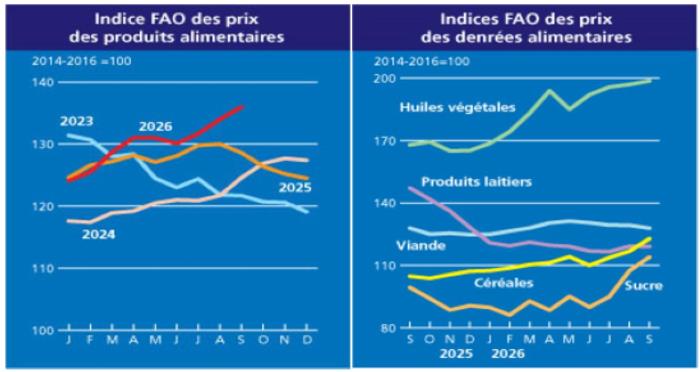
Trade disruptions have contributed to the rise in cereal prices, while poor weather conditions are weighing on sugar production prospects. According to new data released Friday by the United Nations Food and Agriculture Organization (FAO), the FAO’s benchmark index for global food prices rose in September, mainly due to transport disruptions and concerns about weather conditions that have limited supplies, as well as rising prices for several groups of plant-based products.
Trade disruptions have contributed to the rise in grain prices, while poor weather conditions are weighing on sugar production prospects.
According to new data released Friday by the United Nations Food and Agriculture Organization (FAO), the FAO’s benchmark index for global food prices increased in September, mainly due to transport disruptions and weather-related concerns that have limited supply, as well as rising prices for several groups of plant-based products.The FAO Food Price Index, which tracks monthly changes in international prices of a basket of traded food products, averaged 136.0 points in September 2026, up 1.5% from its revised August value and 5.8% above its level a year earlier.”We’re seeing a steady and increasingly widespread rise in global commodity prices, as disruptions in the Strait of Hormuz and the Black Sea combine with climate shocks and put pressure on energy, transport, and several key food items,” said Maximo Torero, FAO Chief Economist. “If these pressures continue, they will quickly affect consumer food prices, especially in countries that rely heavily on food and energy imports.”
The FAO cereal price index has risen by 5.1 percent since August and is now 17.2% higher than it was in September 2025. Global wheat prices went up 6.3% due to logistical issues in the Black Sea region and dry weather affecting parts of North America before planting, while global corn prices increased 5.6% from the previous month because of worries about yields in the United States, lower export availability in Brazil, and trade disruptions in the Black Sea.The current uncertainties surrounding shipping through the Strait of Hormuz have also helped push up the prices of raw materials used for biofuel production, like corn. The FAO index for all types of rice went up by 1.4%, with Indica rice prices rising due to weather concerns and the seasonal tightening of supply.
The FAO vegetable oil price index is up 0.9% from August, driven by higher global palm oil prices, strong global import demand, and worries about the impact of dry weather on production prospects in Southeast Asia.The FAO meat price index fell by 1.1%, with pork and poultry prices dropping due to an abundance of exportable supply. In Brazil, beef export prices went up, driven by stronger demand from the United States, while sheep meat prices remained mostly stable.
The FAO dairy price index decreased by 0.1% in September, as falling cheese prices slightly offset the rise in milk powder prices, while butter prices changed little.The FAO sugar price index rose by 6.1% compared to August, due to the expected tightening of global sugar supplies during the 2026-2027 season. This increase is mainly due to a downward revision of projected sugar production in Thailand and concerns about harvest prospects in India, against a backdrop of below-normal rainfall, the intensifying El Niño phenomenon, heavy rains in Brazil’s main growing area, the Central-South, and a decrease in the area dedicated to sugar beet in the European Union.Global cereal production and trade set to decline
According to the latest FAO Cereal Supply and Demand Brief, published today, global cereal production in 2026 is now expected to fall by 2.1% compared to 2025, reaching 2,979 million tonnes, which would still be the second-largest harvest on record, after last year’s.
These new forecasts take into account an upward revision of wheat production, now expected to reach 813.9 million tonnes thanks to improved weather conditions in Australia. However, this revision is more than offset by a downward reassessment of coarse grain production, now forecast at 1,612 million tonnes, due to less favorable yield prospects in the European Union and the United States, caused by hot and dry weather conditions.Global rice production is now expected to reach 552.5 million tons, with a drop in production prospects in India—mainly due to uneven monsoon rains—outweighing more favorable forecasts for Japan and Nepal.
The FAO has slightly raised its forecasts for total global cereal use in 2026-2027, which now stands at 2,966 million tons. This revision takes into account a rise in the use of coarse grains, a decline in wheat use, and unchanged rice forecasts compared to last month.Global grain stocks at the end of the 2027 campaigns are expected to remain stable compared to their opening levels, at 950 million tons, with the anticipated increase in wheat and barley stocks more than offsetting the decrease in rice and sorghum stocks. So, by the end of the 2026-2027 campaigns, the global grain stock-to-use ratio is now at 31.7%, which is slightly lower than the previous campaign’s level of 32.0%.The FAO also expects a 3.5% drop in global cereal trade compared to the record levels reached in 2025-2026, with trade projected to total 505.8 million tons. The decline in wheat and corn exports is expected to be bigger than predicted, mainly due to ongoing constraints on shipping routes in the Black Sea and limited alternative transport capacity. International rice trade is expected to dip 2.2% in 2026 before bouncing back 1.7% in 2027.

