
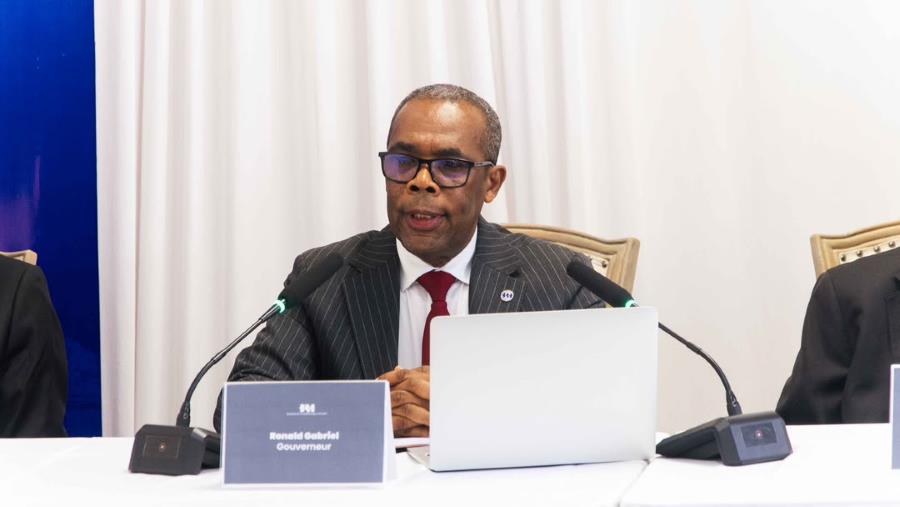
The governor of the central bank, Ronald Gabriel, spoke about ‘the economic and financial issues of migration dynamics in Haiti’ during the BID Reflection Wednesday on September 23, 2026.
The governor of the central bank, Ronald Gabriel, spoke about “the economic and financial challenges of migration dynamics in Haiti” during the BID Reflection Wednesday on September 23, 2026. “Diaspora remittances are one of the pillars of the Haitian economy. They fund a large part of household consumption, are a major source of foreign currency, and indirectly support tax revenues through domestic demand. Their weight in the economy is much higher in Haiti than in the rest of the region, and most of these flows come from the United States. So, any American decision that affects the ability of Haitian migrants to live and work legally in that country deserves special attention,” the governor said.”This is the case with TPS. Granted to Haiti after the 2010 earthquake and renewed several times, this status experienced two major periods of restrictions, in 2017 and then starting in 2025,” he went on.”The question we’re asking is simple to put: what would happen to Haiti’s economy if remittances were to drop significantly and unexpectedly? However, we need to highlight an important caution: we shouldn’t confuse a change in migration policy with an automatic shock in remittances. Between a decision about migration status and the actual flow of remittances to Haiti, there’s a whole chain of transmission, involving residence status, employment, migrants’ income, and their ability to send money,” says Ronald Gabriel, emphasizing that “at each stage, migrants have means of coping, like savings, an alternative job, or adjusting how they send money.”
“So, the TPS is a potential risk factor for transfers, not an automatic determinant of their evolution. This distinction is important because it also defines how we should approach the issue in terms of economic policy: with caution, but also with care and analytical rigor,” according to Governor Ronald Gabriel.“A shock to transfers would first and foremost be a shock to household income. But its effects could then spread to several parts of the macroeconomic system. These mechanisms are all interconnected. So a drop in transfers can gradually become a phenomenon affecting exchange rates, reserves, and the budget position at the same time. This is where the real challenge for a central bank lies. It’s not just about figuring out how big a drop in transfers might be. The key is understanding how that drop would ripple through the whole macro-financial system and over what time frame. The initial findings from the Research Directorate in Economics and Finance (DREF) are going exactly in that direction,” said the governor of the BRH.”Migration dynamics are certainly a fundamental social and human reality. But for an economy like Haiti’s, they have also become an important VARIABLE in our macroeconomic framework. Our collective responsibility is therefore to better understand this relationship, gauge its vulnerabilities, and strengthen our ability to anticipate,” he said, adding that “it is up to us, therefore, not to speculate on what might happen, but to quantify the mechanisms and build the relevant scenarios that will allow us to prepare the appropriate responses.”

