
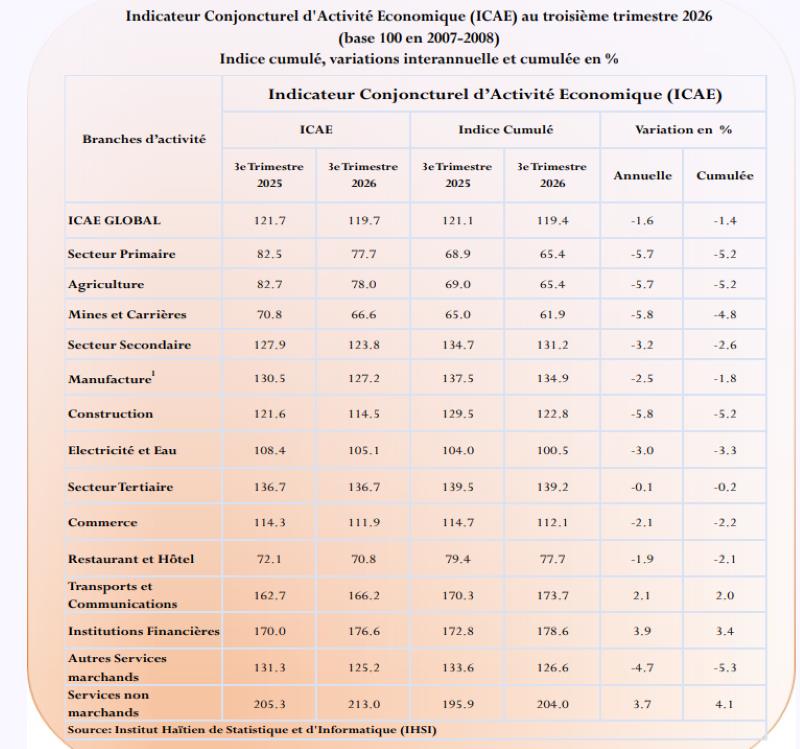
The overall index of the Economic Activity Conjunctural Indicator (ICAE) continues to shrink, showing a level of 119 in the third quarter (April-June) of the 2025-2026 fiscal year.
The overall Index of the Economic Activity Conjunctural Indicator (ICAE) continued to decline, showing, in the third quarter (April-June) of the 2025-2026 fiscal year, a level of 119.7, compared to 121.7 in the third quarter of 2024-2025, which is a 1.6% decrease on an annual basis. Meanwhile, the cumulative ICAE from October 2025 to June 2026, compared to the same period last year, dropped by 1.4%. The CAE results for the third quarter of 2026 reflect the downward trend in the three sectors of the economy.Analysis of the PPI in the Primary Sector
The Primary Sector PPI recorded a year-on-year decline of 5.7% in the third quarter of fiscal year 2025-2026, representing a cumulative drop of 5.2% from October to June of fiscal year 2026. This underperformance in the primary sector comes from the combined decrease in both sub-branches, namely agriculture and extractive activities.Agriculture:
The ICAE of the agricultural sector, in the third quarter of the 2025-2026 fiscal year, fell by 5.7% year-on-year. This decline is slightly more pronounced than in the second quarter, where it was -5.5%. The agricultural sector continues to suffer from the negative effects of a poor rainy season on the farming campaign. Cumulatively, over the first three quarters of the 2026 fiscal year, there is a decrease of 5.2%.
Extractive Activities:
The ICAE of the extractive activities, during this quarter, recorded a drop of 5.8% year-on-year.The negative result of this sector, which is mainly made up of sand and gravel quarries, reflects the ongoing difficulties seen in the Construction sector. On a cumulative basis, over the nine months of the 2025-2026 fiscal year, extractive activities fell by 4.8% compared to the same period last year.
Analysis of the ICAE of the Secondary Sector
Compared to the 3rd quarter of the 2024-2025 fiscal year, when the growth rate was -4.7%, the ICAE of the secondary sector dropped again in the 3rd quarter of the 2025-2026 fiscal year, but at a slower pace, at 3.2%. All components of the sector contributed to its negative performance during the quarter under review. On a cumulative basis, from October 2025 to June 2026, the ICAE of the secondary sector recorded a contraction of 2.6%.Manufacturing Industries: From April to June 2026, the index for the manufacturing industries sector recorded an overall drop of 2.5%, on an annualized basis. This decline is mainly due to the slowdown in the manufacturing of textiles, chemicals, non-metallic mineral products, and metallurgical works. On the other hand, the ‘Manufacture of food, beverages, and tobacco’ sector saw positive growth during this period. Overall, over the nine months from October 2025 to June 2026, the manufacturing industries index fell by 1.8%.Construction: The ICAE in the Construction sector fell again (-5.8%) year-on-year in the third quarter of the 2025-2026 fiscal year compared to the same period of the previous fiscal year. This negative trend is partly due to difficulties accessing certain sand and gravel quarries located in areas affected by insecurity, where armed groups have settled. This situation limits extraction and, consequently, the supply of sand and gravel for construction activities. Cumulatively, over the period from October 2025 to June 2026, the ICAE in the Construction sector dropped by 5.2% compared to the same period of the previous fiscal year.Electricity and Water: The ICAE of the Electricity and Water Production and Distribution branch contracted by 3% on an annualized basis in the third quarter of the 2025-2026 fiscal year. Both sub-branches, namely Water and Electricity, are behind this decline. Over the first nine months of the fiscal year, the branch’s ICAE recorded a cumulative drop of 3.3%.
Slight increase in the ICAE of the Tertiary Sector: The tertiary sector recorded a negative annual growth of 0.1% from April to June of the 2025-2026 fiscal year. This contraction, however, is less pronounced than the 0.4% observed in the same period of the previous fiscal year. Except for the Transport and Communications, Financial Institutions, and Non-market Services branches which grew, all other components contributed to the decline of the sector’s ICAE. In total, the ICAE of the tertiary sector decreased by 0.2% over the first three months Commerce: The Commerce sector index stood at 111.9 in the third quarter of fiscal year 2025-2026, compared to 114.3 in the same period of the previous year. This represents an annual contraction of 2.1%, after a 2.7% drop recorded a year earlier. This downward trend in commercial activity is due to the decline observed in both sub-sectors of the branch, namely the informal sector, down 1.9%, and the formal sector, which decreased by 2.4%. Over the first nine months of fiscal year 2025-2026, the Commerce sector index showed a cumulative decrease of 2.2%.Restaurants and Hotels: The index for the Restaurants and Hotels sector saw a negative annual growth of 1.9%, dropping from 72.1 in the third quarter of the 2024-2025 fiscal year to 70.8 in the third quarter of the 2025-2026 fiscal year. This downward trend is reflected in the shrinking revenue of businesses in this sector. The cumulative change from October 2025 to June 2026 shows a decline of 2.1%.Transport and Communications: The ICAE for the Transport and Communications sector saw a year-on-year growth of 2.1% in the third quarter of the 2025-2026 fiscal year, after a moderate increase of 1.0% during the same period of the previous fiscal year. This positive trend comes from growth in both sub-sectors: transport, which rose by 1.0%, and communications, which went up by 2.9%. Overall, in the first nine months of the 2025-2026 fiscal year, the ICAE for Transport and Communications increased by 2.0% compared to the same period of the previous fiscal year.Financial Institutions: The ICAE of financial institutions posted an annual increase of 3.9% in the third quarter of fiscal year 2025-2026. However, this growth is slightly lower than the 4.4% recorded during the same period of the previous fiscal year. This positive trend is mainly driven by a 4.3% rise in commercial banks’ output. Overall, from October 2025 to June 2026, the ICAE of financial institutions grew by 3.4%.
Other Market Services: The index for the Other Market Services sector, which includes the real estate, health, and education subsectors, saw an annual decline of 4.7% in the third quarter of fiscal year 2025-2026. This contrasts with the 1.3% increase observed in the same period of the previous fiscal year. This drop is mainly due to underperformance in the Health and Real Estate subsectors. Over the first nine months of fiscal year 2025-2026, the sector’s ICAE fell cumulatively by 5.3% compared to the same period in fiscal year 2024-2025.
Non-Market Services: The ICAE for non-market services grew by 3.7% year-on-year in the third quarter of fiscal year 2025-2026, slightly higher than the 3.5% increase recorded in the same period of the previous fiscal year. In cumulative terms, over the period from October 2025 to June 2026, the index of s Contribution of sectors to the evolution of the overall ICAE in the third quarter of 2026
The contributions of the sectors to the evolution of the overall ICAE in the third quarter of fiscal year 2026 are distributed as follows:
a) Positive contributions: Transport and Communications (0.30%); Financial Institutions (0.04%); Non-Market Services (0.05%);
b) Negative contributions: Trade (-0.43%); Agriculture (-0.67%); Manufacturing activities (-0.40%); Construction (-0.28%); Market Services (-0.15%); Extractive activities (-0.01%); Hotels and Restaurants (-0.01%) and Electricity and Water (-0.01%).

