
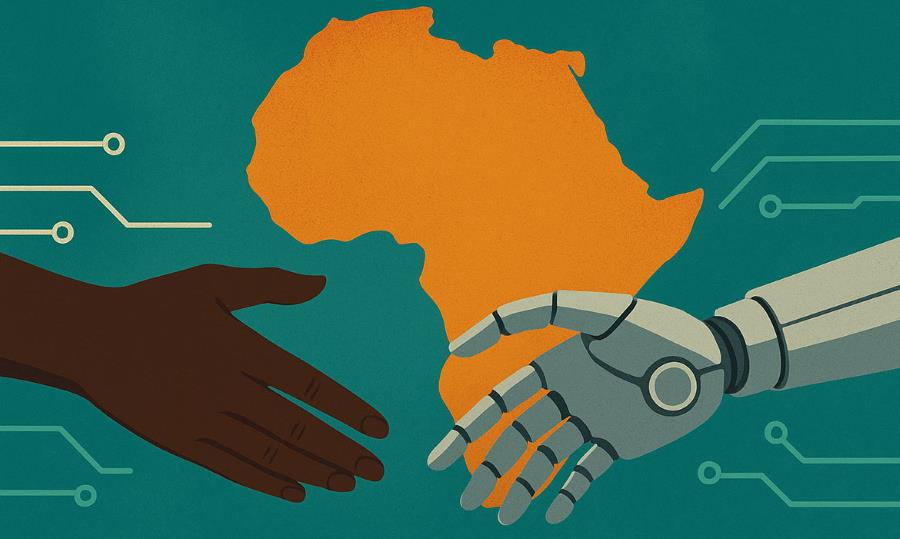
As artificial intelligence spreads rapidly across the continent, the challenge for Africa is no longer just about accessing technologies developed elsewhere, but about creating tools that suit its own needs.
As artificial intelligence spreads rapidly across the continent, the challenge for Africa is no longer just about accessing technologies developed elsewhere, but about creating tools suited to its own needs. For Girmaw Abebe Tadesse, a member of an international scientific group supported by the UN, this goal requires increased cooperation between governments, researchers, companies, and African youth.
Before talking about models, data centers, or computing power, Girmaw Abebe Tadesse asks a much simpler question: what should artificial intelligence be used for in Africa?”We try to start from the reality of our environment and apply artificial intelligence technologies to the problems we face locally. It’s important to first ask ourselves which problems we want to solve,” explains this Ethiopian expert to UN News, who leads Microsoft’s AI for Good lab in Kenya.
A member of the United Nations-supported Independent Global AI Expert Group, Mr. Tadesse advocates an approach that flips the logic often followed in the global AI race: not starting with the available technology and then trying to find something to apply it to, but starting with the needs to determine the tools required.It’s only once the problems are identified, he explains, that comes the time to figure out the infrastructures, technologies, and data needed to address them. Mostly, it’s a way to avoid African countries just importing systems designed elsewhere, based on different economic, social, or linguistic realities.Girmaw Abebe Tadesse, member of the Independent International Panel of Scientific Experts on AI (on the left), pays a courtesy visit to Zainab Hawa Bangura, director of the United Nations office in Nairobi. Starting from African realities
The issue takes on particular importance as AI is rapidly gaining ground in education, health, agriculture, business, and public services across Africa. It was also at the heart of discussions held in New York during the UN General Assembly high-level week, where political leaders, experts, and heads of major tech companies debated how to regulate a technology whose development remains largely concentrated in a few countries and companies.
For Mr. Tadesse, Africa actually has a considerable asset: its youth. The continent combines a young population, rapid adoption of digital tools, and the emergence of a generation of entrepreneurs and researchers who are already looking to put technology to work on local problems.”Many young people are already using technology to tackle the challenges their communities face, while investors and development partners are ready to support their initiatives,” he points out.
But turning this potential into real innovation capacity requires breaking down silos. Governments, universities, development partners, creative industries, and tech companies need to share their data, knowledge, and skills more, according to him.”When we bring together people with different backgrounds, we can rely on existing knowledge and expertise to develop the solutions our communities need,” he says.
It’s also an economic issue. In countries where financial resources, digital infrastructure, and computing power remain limited, trying to match the investments made by major tech powers would be hardly feasible. Cooperation can therefore help pool scarce resources and prevent each country from trying to build its own capacities in isolation.

