
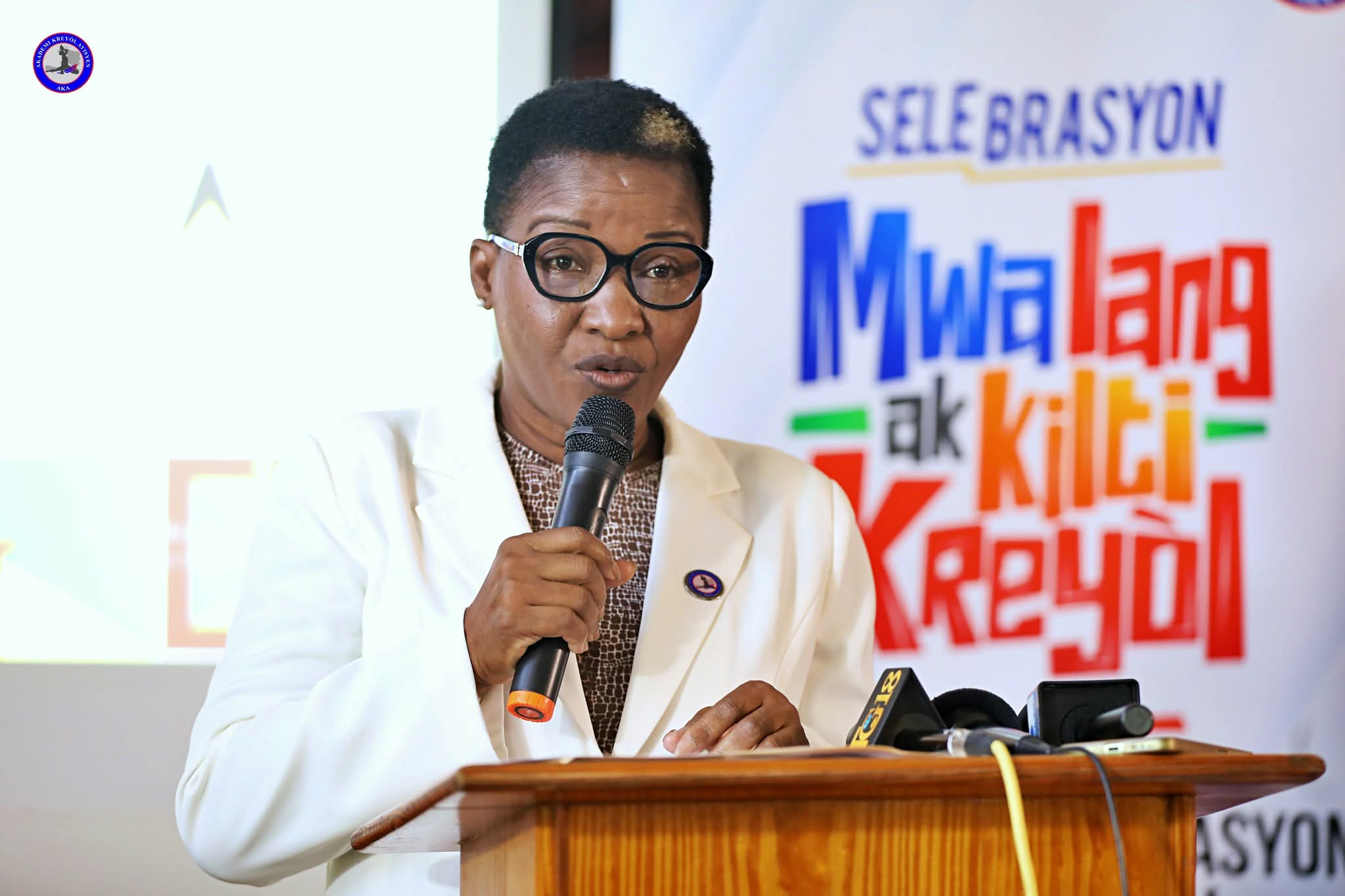
During the opening ceremony of the Haitian Creole Language and Culture Month Celebration for October 2026, the president of the Haitian Creole Academy (AKA), scholar Rosilia François Corneille, spoke in front of members of the press, academics, advisory council members, the executive secretary and her team, representatives from public and private institutions, teachers, researchers, writers, artists, students, and other guests gathered in the Academy’s conference hall in Bwavèna.
During the opening ceremony of the Haitian Creole Language and Culture Month Celebration for October 2026, the president of the Haitian Creole Academy (AKA), academician Rosilia François Corneille, spoke in front of representatives of the press, academics, advisory council members, the executive secretary and her team, representatives of public and private institutions, teachers, researchers, writers, artists, students, pupils, and other guests gathered in the Academy’s conference hall in Bwavèna.
In her speech, academician Rosilia François Corneille presented the theme of the 2026 celebration, which is: “Creole Language: a force for creation and knowledge.” She emphasized the importance of this theme for Haitian society, while reminding everyone that the Creole language is not just a means of communication. According to her, Creole is a tool for creating, thinking, learning, sharing knowledge, building identity, and contributing to the country’s development.He emphasized the need for society to encourage the creation, reflection, learning, and sharing of knowledge in Creole. He also reminded everyone that Creole is the language we live in, the language we think in, the language we use to tell our experiences, the language we express our emotions in, the language we sing and write in, as well as the language we use to pass knowledge from one generation to the next.
The AKA president insisted that Haitians take part in the development of the Creole language and use it in all areas of national life. It’s his way of saying that this tremendous work goes beyond just a linguistic issue. For him, it’s a task that carries social, educational, cultural, and political dimensions.Tribute to Joseph C. Bernard, former Minister of National Education
On the occasion of the celebration, the Haitian Creole Academy chose to pay special tribute to the former Minister of National Education, Joseph C. Bernard, for his contribution to the reflection and reform of the Haitian education system, recalling the role he played in considering the place of the Creole language in teaching, especially within what is called the Bernard Reform.
According to the AKA president, Joseph C. Bernard’s vision was based on the academic necessity, highlighted by Corneille, for children to be able to learn in a language they understand, a language that allows them to participate, ask questions, think, create, and develop their abilities. In this sense, the Academy’s tribute goes beyond the personality of the former minister; it also represents a vision of education that gives the language children understand an important place in the construction of knowledge.The academic emphasized that these issues remain relevant several decades after major changes were made in the education system. They believe there is a need to continue working so that Creole gets all the recognition it deserves in schools, universities, public administration, science, technology, culture, media, and all other spaces where knowledge is produced and circulated.
In the same vein, they reminded us of the Haitian Creole Academy’s commitment to continue working to develop, preserve, document, and promote the Creole language, and to use it in all fields. They highlighted the need to put Creole in dialogue with other languages while giving it the capacity to respond to the needs of Haitian society.
The AKA president defended the idea that Creole can serve as a language of science, teaching, and research, as well as a language of literature, media, technology, administration, and innovation. In this vision, Creole is not just a language of communication, but it is a language of creation and knowledge production.In Boutofen, academic Rosilia François Corneille invited all sectors of society to participate in the activities of Creole Language and Culture Month, presenting October as a time for reflection, dialogue, creativity, and action in favor of the Creole language. She thanked all institutions, partners, academics, teachers, journalists, media, researchers, writers, artists, young people, and citizens contributing to the work for the Creole language.
She concluded with a call for everyone to continue writing, teaching, researching Creole, using it, and passing it on to future generations, so that the language continues to be an important tool for creating, learning, sharing knowledge, and building a society where everyone can participate.

