
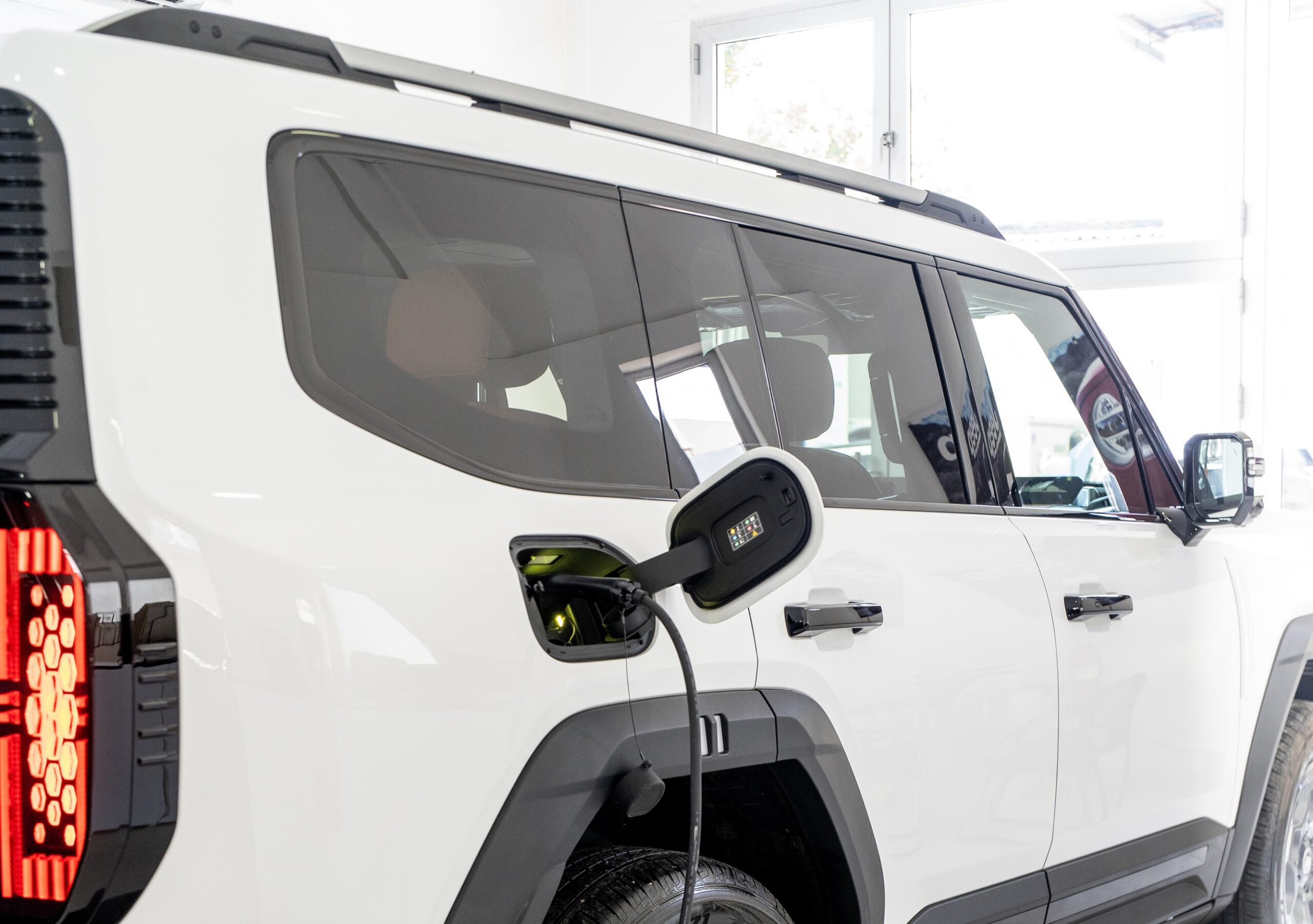
Between fuel prices, deficiencies in the electrical grid, and the rapid development of private solar energy, this technology could find a unique foothold in Haiti.
The rechargeable vehicle is making its debut on the Haitian automotive market. Caribe Motors is introducing two plug-in hybrid models, or PHEVs (Plug-in Hybrid Electric Vehicles): the Jetour G700, a large off-road SUV, and the GAC S7, a family SUV.
According to Jean Marc Lebrun, general manager of Caribe Motors, these would be the first plug-in hybrid vehicles officially sold in Haiti by an authorized dealer, with manufacturer warranty and local after-sales service. The company says it has been working on this project for two years.
But beyond the arrival of two new models on the market, the initiative raises a bigger question: can the rechargeable vehicle make economic sense in Haiti?The question might seem paradoxical in a country where electricity supply remains insufficient and where there is practically no public charging infrastructure. But the evolution of the Haitian energy sector has a particularity: faced with deficiencies in the public grid, many households and businesses have invested in their own electricity production, notably through solar installations coupled with batteries.
It’s in this context that the plug-in hybrid could try to find its place.Electric for the city, gas for long distances
The PHEV sits halfway between a conventional car and a fully electric vehicle.
It has a gas engine, but also a battery big enough to handle trips in full electric mode. Unlike a regular hybrid, its battery can be plugged into an external power source to recharge.This difference is important in the Haitian context.
A fully electric car requires being able to find a charging source before the battery runs out. However, Haiti doesn’t yet have a real public network of charging stations. On a trip between Port-au-Prince and a provincial town, the availability of a charging station can’t be taken for granted.
The PHEV partially gets around this problem. When its battery is sufficiently charged, it can run on electricity. When it runs out, the gas engine allows the journey to continue.It’s actually this energy constraint that influenced Caribe Motors’ decision to first introduce plug-in hybrids rather than fully electric vehicles.
According to the manufacturers’ data, both models launched have an electric range of around 150 kilometers. The Jetour G700 comes with a 34 kWh battery, and the GAC S7 has a 36.3 kWh battery. With a full charge and a tank of gas, their total announced range exceeds 1,000 kilometers.
However, these numbers are still theoretical. Constant use of air conditioning, traffic jams, terrain, and driving habits can significantly affect real-world range. Caribe Motors also acknowledges that the performance observed in Haiti is likely to be lower than the manufacturers’ stated figures.The real calculation will happen at the pump
The economic benefit of a PHEV will depend less on its total range than on how many kilometers it can let its owner drive without buying gasoline.
A driver who mostly makes city trips and charges their car every day could theoretically use very little of the gasoline engine during the week. On the other hand, someone who never charges their PHEV loses a big part of this advantage.
This calculation becomes particularly important with the current level of fuel prices. Since August 10, the official price of gasoline has been set at 700 gourdes per gallon, compared to 770 gourdes for diesel.Caribe Motors takes the example of a big SUV driving about 40 kilometers a day in Port-au-Prince traffic. According to the company’s estimates, a gas vehicle of this category could use around 40 gallons of fuel per month for this level of use. At 700 gourdes per gallon, that comes to about 28,000 gourdes in monthly fuel costs.
That doesn’t automatically mean a PHEV will save you 28,000 gourdes a month.
The electricity needed to charge its battery also has a cost. So, the real savings depend on the energy source used, the distance driven, how often you charge, and the consumption of the vehicle the PHEV is being compared to.
This is where Haiti’s unique energy situation becomes a key factor.Solar changes the equation
In a country with a reliable power grid, a rechargeable car is usually plugged into the home network at night. In Haiti, the development of electric mobility could take a different path.
Faced with the limited availability of Ed’H, a growing number of homes and businesses have developed their own solar energy production and storage capacities. For those that already have a sufficiently sized system, charging a vehicle can be added to existing uses without relying solely on Ed’H.To travel about 30 kilometers a day, the two vehicles introduced by Caribe Motors would require, according to the company’s estimates, between 7 and 10 kWh of energy. An additional solar capacity of around 2 to 3 kWc could generate this amount on a favorable day.
The benefit is even clearer when a solar setup already exists and produces, during certain hours of the day, more energy than the house or business consumes. Some of this surplus can then be directed to the vehicle.It would still be misleading to talk about a “free” recharge. Panels, batteries, inverters, and other equipment are an investment, have a lifespan, and will eventually need to be replaced. But for a household or business that has already made this investment to secure its electricity supply, adding a rechargeable vehicle can positively affect the economic calculation.
This is perhaps where the main peculiarity of the Haitian market lies: the weakness of the public grid, which is a drawback for electric vehicles, has at the same time pushed part of the population and businesses to develop private energy infrastructure that could make adoption easier.And in the mountains?
The terrain is another concern in a country where a large part of the road network goes through mountainous areas.
On this kind of terrain, electric vehicles have some interesting features. The electric motor delivers its torque immediately, which helps with starts and uphill acceleration. Going uphill, however, the effort required increases energy consumption and reduces the available range.
On the way down, you can recover some of this energy thanks to regenerative braking. Instead of wasting all the vehicle’s energy as heat in the brakes, the electric motor acts as a generator and sends electricity back to the battery.Caribe Motors estimates, for example, that a descent from Kenscoff to Pétion-Ville could allow you to recover the equivalent of several kilometers of range. The actual result will, however, depend on the vehicle, the battery’s charge level, traffic, driving style, and road conditions.
Regenerative braking also has another benefit on long descents: it reduces the strain on the mechanical brakes and therefore their heating.A different kind of maintenance, but not nonexistent
Plug-in hybrids don’t eliminate the maintenance costs of a conventional vehicle either.
Since they still have a gasoline engine, oil changes and some mechanical maintenance are still necessary. However, if a significant portion of trips is done in electric mode, the internal combustion engine runs less often. Regenerative braking can also reduce wear on brake pads and discs.
Caribe Motors estimates that maintenance costs should be comparable to, or even lower than, those of an equivalent gasoline vehicle. The batteries in the introduced models come with an eight-year “manufacturer” warranty. The dealer also says it has trained its technicians on high-voltage systems and started to stock parts for these vehicles.These factors, however, will need to be assessed over time. The cost of owning a vehicle isn’t just about fuel consumption. It also includes the purchase price, maintenance, parts, insurance, depreciation, and, for a rechargeable vehicle, possibly the equipment needed for charging.

