
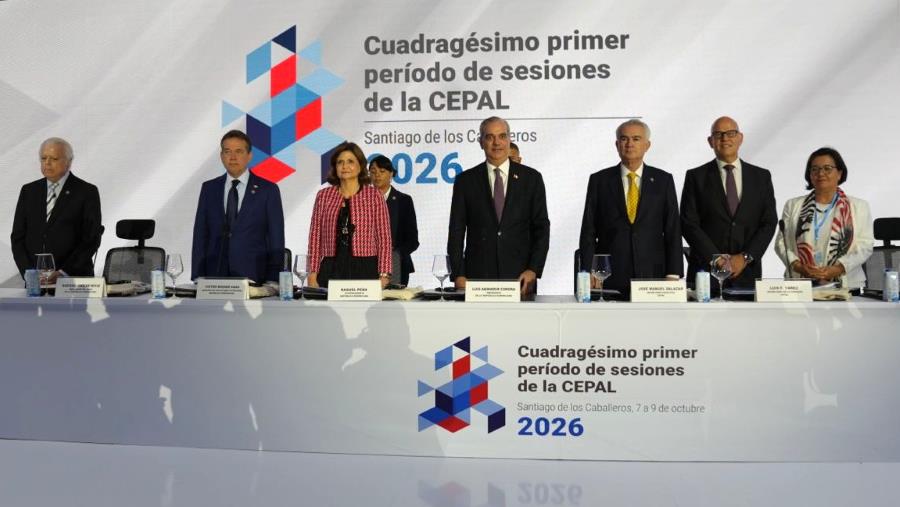
In the presence of the President of the Dominican Republic, Luis Abinader, the authorities inaugurated the forty-first session of ECLAC on October 7, 2026, in Santiago de los Caballeros.
In the presence of the President of the Dominican Republic, Luis Abinader, the authorities inaugurated the forty-first session of ECLAC on October 7, 2026, in Santiago de los Caballeros.
Latin America and the Caribbean need to strengthen their institutional capacities and deepen regional integration to manage the major changes required by the new global geopolitical and geoeconomic context. This was agreed on Wednesday by the representatives of the countries in the region during the inauguration of the forty-first session of ECLAC, which continues until Friday, October 9, in Santiago de los Caballeros, Dominican Republic.On the occasion of the opening of its most important biennial meeting, the Economic Commission for Latin America and the Caribbean (ECLAC) invited countries to understand, anticipate, and successfully adapt to the new global context, and to consider possible ways to tackle development challenges – the ‘hows’ – by presenting a new framework for analyzing governance and institutionalization, focused on the paradigm of managing transformations as a prerequisite for sustainable structural changes.The event was kicked off by Luis Abinader Corona, President of the Dominican Republic; José Manuel Salazar-Xirinachs, Executive Secretary of ECLAC; and Gustavo Lembcke Hoyle, Ambassador of Peru to the Dominican Republic, representing the country that held the presidency of the fortieth ECLAC session.
Those who attended the opening ceremony included Raquel Peña, Vice President of the Dominican Republic; Michelle Bachelet Jeria, former President of Chile and co-chair of the ECLAC Commission on Geopolitics, Globalization, and Development for Latin America and the Caribbean; Victor Bisonó, Minister of Foreign Affairs of the Dominican Republic; Carla Barnett, Secretary-General of the Caribbean Community (CARICOM); Albert Ramdin, Secretary-General of the Organization of American States (OAS); Lina Ajoy, Secretary-General of the Central American Integration System; and Julia Sánchez, UN Resident Coordinator in the Dominican Republic, among other figures.“We are living in a time of profound upheavals. Modes of production, commercial relationships, and international balances are changing. Artificial intelligence is transforming work, knowledge, and services at a speed that forces us to make decisions just as quickly. At the same time, our citizens are sending us a very concrete demand: opportunities, security, and the chance to build a future through their efforts. The question we need to answer is this: how can we turn these transformations into well-being for our people? How can we prevent a new era of innovation from repeating the inequalities we still haven’t managed to overcome? No country in our region can tackle all these challenges alone. We need to listen to each other, learn from one another, and cooperate more effectively.”The diversity of Latin America and the Caribbean can be a strength if we are able to forge lasting agreements. That is the whole point of this meeting,” said President Luis Abinader.
Ambassador Gustavo Lembcke Hoyle, for his part, highlighted the work done by Peru over the past two years: “It was an honor to hold the presidency. We are confident that we have made a constructive contribution to the work of the Commission and to the joint efforts of our countries for more productive and sustainable development. We acknowledge CEPALC’s valuable contribution to economic and social thinking in Latin America and the Caribbean, to public policy development, and to strengthening regional dialogue and cooperation within a multilateral framework,” he said.The Executive Secretary of ECLAC, José Manuel Salazar-Xirinachs, at the time of presenting the document titled Managing Transformations in the Age of Disruptions
In his opening speech, José Manuel Salazar-Xirinachs emphasized that “the ECLAC session is an opportunity for reflection. Yet, this reflection has become a rare commodity. Overwhelmed by emergencies and endless crises, it’s easy to lose sight of the bigger picture. This meeting allows us to take a step back, look up, and understand how the context and conditions of development in Latin America and the Caribbean have evolved. It’s an opportunity to think about development as a deliberate, conscious, and voluntary exercise. Because, as we have said many times, more productive, inclusive, and sustainable development is not inevitable; it won’t happen automatically, but requires a clear, broad, and sustained vision and commitment from the different sectors of society.At the end of the opening ceremony, the ECLAC Executive Secretary presented the document titled Managing Transformations in an Era of Ruptures, a comprehensive and updated publication that reflects the Commission’s in-depth thinking. This document lays out a strategic vision for Latin America and the Caribbean, looks at the current global geopolitical landscape — along with its main dynamics and implications — and analyzes the challenges this context poses for development policies and the international integration of the region’s countries.The ECLAC position paper will be thoroughly analyzed during a high-level technical seminar organized into three panels: i) a new stage of regional integration: what to do and how to move forward; ii) digital transformation, artificial intelligence and productive development; and iii) macroeconomics serving development and solid, effective taxation.
“Development involves transformation; so learning to manage transformations is basically learning to steer development with intention and a strategic vision,” said the ECLAC Executive Secretary.This institutional publication is based on the recently released report titled Ruptures and Opportunities: Proposals for Latin America and the Caribbean to Thrive in the New Geopolitical Era. Prepared by the ECLAC Commission on Geopolitics, Globalization, and Development for Latin America and the Caribbean, the report will be presented on Thursday, October 8, during the Dialogue of Ministers and High-Level Authorities, designed as a special space for political reflection and strategic dialogue about the region’s future.
The forty-first session of ECLAC marks the start of the Dominican Republic’s presidency—which will last until the next session in 2028—and the end of the current term held by Peru since the fortieth session, held in Lima in 2024.

