
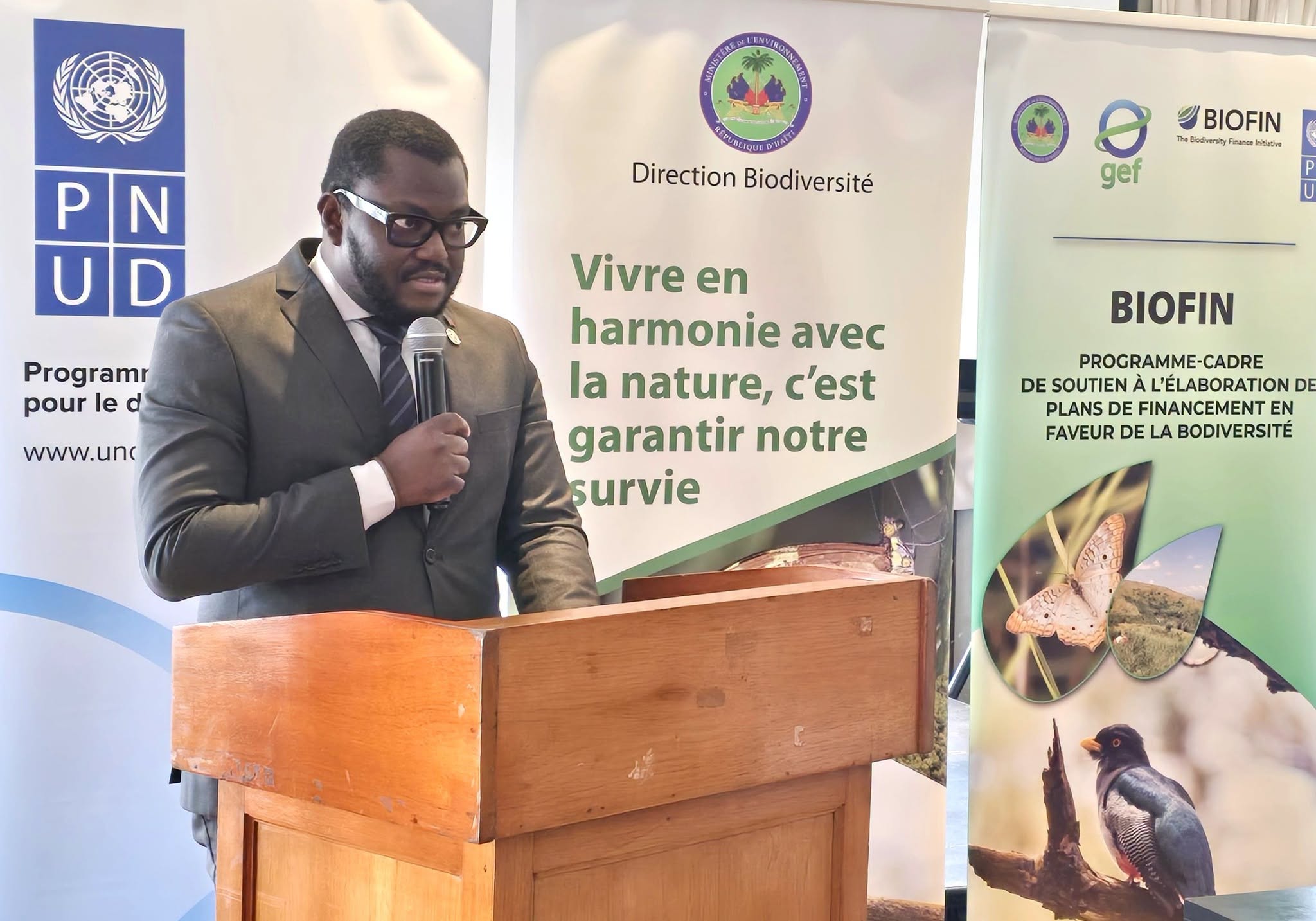
The Ministry of the Environment brought together all the relevant stakeholders from October 6 to 8, 2026, at the Karibe Convention Center hotel in Port-au-Prince to approve the 7th National Biodiversity Report and the 2026-2030 Biodiversity Financing Plan.
The Ministry of the Environment brought together all the relevant stakeholders from October 6 to 8, 2026, at the Karibe Convention Center Hotel in Port-au-Prince to validate the 7th National Report on Biodiversity and the 2026-2030 Biodiversity Financing Plan. The goal: to decide on the priorities that Haiti will present at COP17, scheduled in Armenia.Students, experts, representatives from public institutions, local authorities, and universities, civil society, the private sector, technical and financial partners: everyone took part in the discussions. The process was meant to be participatory, with consultations held in several departments, including Grand’Anse, Sud, Nippes, Sud-Est, and Nord. The work was kicked off by the Minister of Environment, Valéry Fils-Aimé, the Director of Biodiversity, Michelet Louis, the Director General of the Ministry, Emmanuel Philippe, and the Head of the UNDP Resilience Unit, Jean Ronald Alexandre.Approved on October 5, 2026, the 7th National Report highlights notable progress, primarily the expansion of protected areas, which are considered essential for the conservation of species and ecosystems. “The increase in protected areas is important for biodiversity conservation,” emphasizes Michelet Louis.
However, these achievements remain fragile. The Director of Biodiversity points to limited resources, insecurity, and the precarious conditions in which some populations live. Lacking economic alternatives, vulnerable communities put increased pressure on natural resources. The report takes this reality into account.Developed within the framework of the Convention on Biological Diversity, the document takes stock of the progress made, the obstacles faced, and the outlook for Haitian biodiversity. It should also feed into the global assessment of the implementation of the Kunming-Montreal Global Biodiversity Framework.Making biodiversity a development lever
For Minister Valéry Fils-Aimé, protecting biodiversity cannot be separated from the country’s economic and social challenges. He advocates for an approach that puts it at the heart of development policies. “Biodiversity should not only be seen as a heritage to protect, but also as a lever for Haiti’s development,” he says. From this perspective, ecosystems are no longer just areas to preserve: they are also essential resources for agriculture, fishing, food security, the economy, and community livelihoods.The potential is huge. Haiti is part of the Caribbean islands’ biodiversity hotspot, notes the ministry. The country is home to between 5,000 and 5,600 species of vascular plants and over 2,000 animal species. On top of that, there are 31 key biodiversity areas, including 14 coastal or marine, and 14,243 hectares of mangroves. This heritage is essential for conservation, research, and nature tourism.
A big part of preparing for COP17 happens on the ground in terms of resources. Developed within the BIOFIN initiative, the 2026-2030 Biodiversity Financing Plan aims to define strategies to mobilize funds nationally and internationally. For Michelet Louis, the directions and actions already exist; putting them into practice depends on the ability to gather the necessary resources. ‘The actions are there, but we need to add the resources necessary to implement them,’ he believes.The plan should support capacity building, technology transfer, ecosystem restoration, and the protection of marine and coastal biodiversity. For an island country like Haiti, this last aspect is strategic, as the country’s marine and coastal wealth is closely linked to economic activities and the livelihoods of local communities.
What challenges for COP17?
The 7th National Report and the Financing Plan will serve as a basis for Haiti’s negotiations in Armenia. Among the identified priorities are the mobilization of financial resources, strengthening national capacities, technology transfer, ecosystem restoration, and better integration of biodiversity into public policies.The challenge is twofold: to better make the country’s needs heard in international discussions and to equip itself with tools to meet its commitments at the national level. The process benefits from the technical and financial support of UNDP, thanks to funding from the Global Environment Facility (GEF).
Michelet Louis finally calls on the population to take part in this effort, as biodiversity, according to him, is essential for the future of humanity. He invites people to live in harmony with nature and to avoid overusing resources. The question remains how Haiti will manage to mobilize the necessary means to turn these commitments into concrete actions on the ground, and to reconcile, over time, biodiversity conservation, economic development, and improvement of living conditions.

