
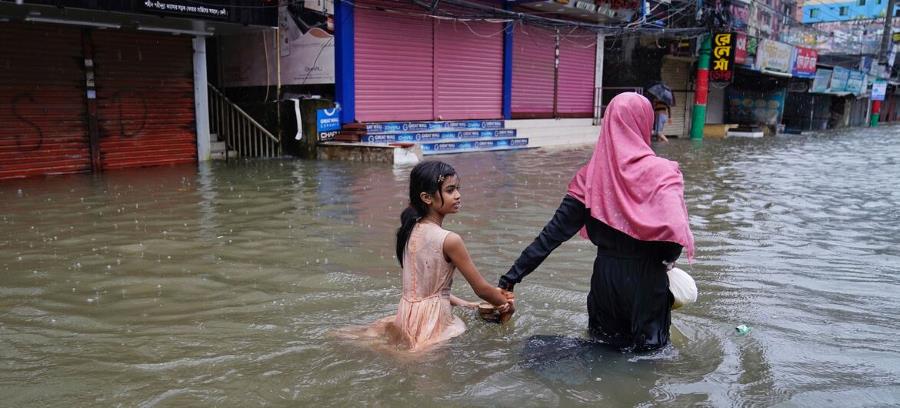
A mother and her daughter are crossing floodwaters in Feni, in southeastern Bangladesh.
A mother and her daughter are crossing floodwaters in Feni, in southeastern Bangladesh.
The world has never had so many solutions to fight climate change. Yet, millions of people and many countries still can’t afford to benefit from them. While clean technologies are making rapid progress, the main challenge of COP31 will be to make sure these solutions are accessible to everyone.
Devastating floods, deadly heat waves, and prolonged droughts marked 2026. At the same time, scientists confirm that the planet is on track to surpass the 1.5°C warming limit set by the Paris Agreement.Adding to this threat is that of a powerful El Niño phenomenon, which could further worsen the effects of climate change.
It is in this context that representatives from more than 190 countries will meet in Antalya, Turkey, from November 9 to 20, for the 31st United Nations Climate Change Conference (COP31).
While fossil fuels remain the main source of greenhouse gas emissions, solutions to move away from them are progressing at an unprecedented pace. Solar energy, electric vehicles, and battery storage are now increasingly accessible.But why do so many countries stay on the sidelines of this transition?
Just days before the summit, UN News spoke with Selwin Hart, Special Adviser to the UN Secretary-General on Climate Action and the Just Transition, about the stakes of this COP, the obstacles slowing progress, and the expected outcomes of the negotiations.
What is COP31 and why is it important?
The acronym COP stands for “Conference of the Parties,” referring to the countries that are members of the United Nations Framework Convention on Climate Change (UNFCCC). These annual meetings allow governments to assess the progress made and negotiate collective responses to a crisis that knows no borders.It was in this context that the Paris Agreement was concluded in 2015, through which countries committed to keeping global warming well below 2°C, while continuing their efforts to limit it to 1.5°C compared to pre-industrial levels.
But COPs are no longer just about negotiations between governments. Companies, scientists, indigenous peoples, young people, and civil society representatives are playing an increasingly important role. “It’s now clearly recognized that to tackle the climate crisis, we need a general mobilization,” says Mr. Hart.

