
By Estelle EMONET For the second year in a row, migration flows to developed countries dropped in 2025 (-1.6%) compared to the previous year, but they remain at a historically high level, just like the employment rate of immigrants, the OECD revealed on Thursday.
By Estelle EMONET
For the second year in a row, migration flows to developed countries fell in 2025 (-1.6%) compared to the previous year, but remain at a historically high level, just like the employment rate of immigrants, the OECD revealed on Thursday.
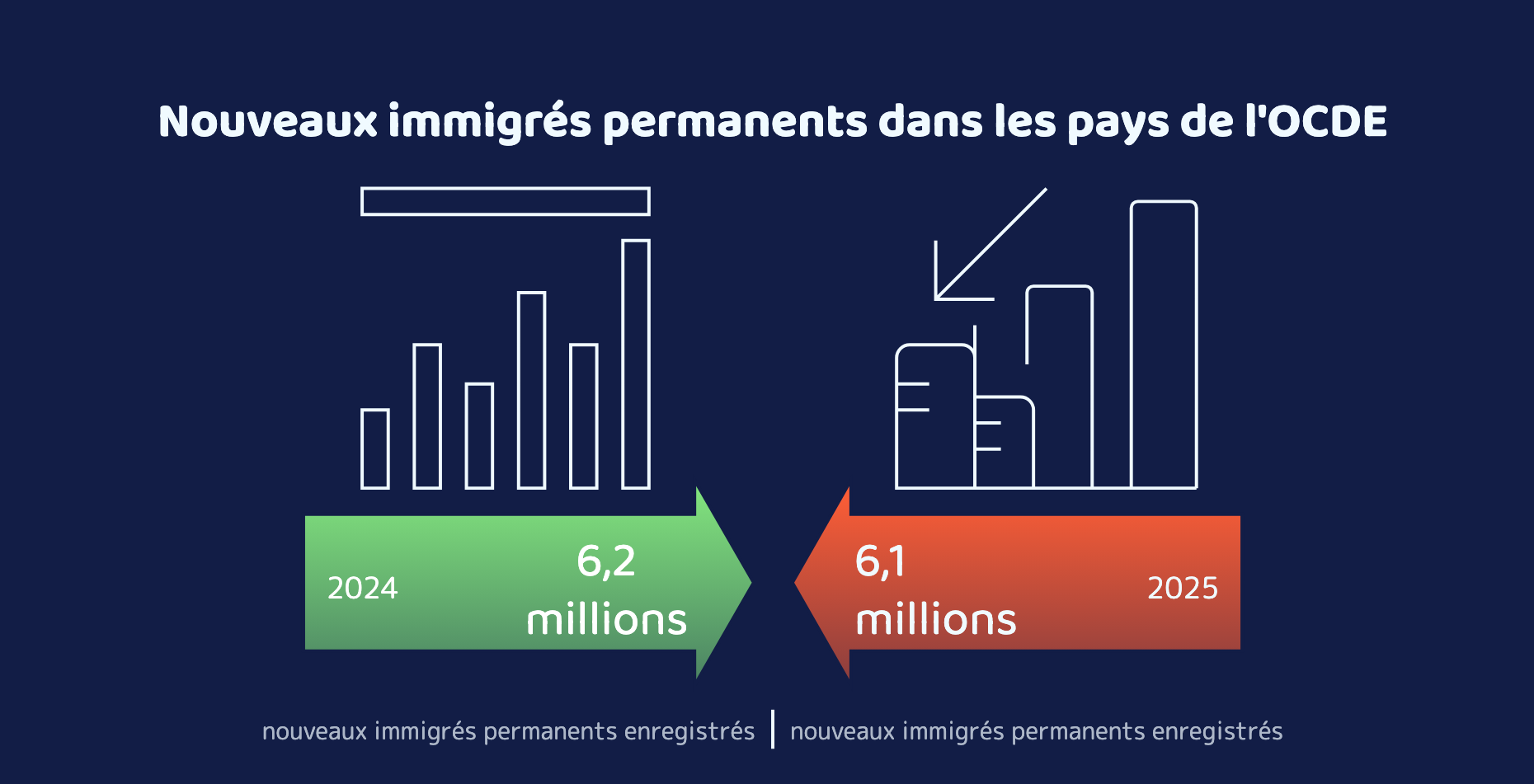
In 2025, the 38 OECD (Organisation for Economic Co-operation and Development) countries recorded 6.1 million new ‘permanent’ immigrants (regulated arrivals of foreign nationals considered to be settling permanently in the destination country), the organization responsible for guiding countries in their public policies wrote in its annual report. In 2024, the number had been 6.2 million.Despite this decline, these arrivals remain at historically high levels, exceeding those observed in 2019 by 12%, before the arrival of Covid, which had slowed down travel.
Three countries stand out with strong increases: Portugal (+139%), due to the approval of pending residence permits, Spain (+25%), thanks to the expansion of regularization mechanisms, and Italy (+46%), driven by family immigration and the opening of new work immigration channels.
France itself recorded a 9% increase in permanent immigration compared to 2024.
On the other hand, the United States (-14%), the United Kingdom (-32%), Canada (-19%), and Germany (-6%) saw notable drops in arrivals of ‘permanent’ immigrants, even though the U.S. is still by far the main immigration country.
The country recorded 1.232 million arrivals, ahead of Germany (+538,000), Spain (+460,000), Canada (+394,000), and France (+334,000).India, the top country of origin –
Despite a sharp decline, India remained the top country of origin for migration flows to the OECD in 2024, ahead of China and Colombia, according to the latest available figures.
Asylum applications (1.1 million) decreased (+22%) in most OECD countries (excluding the United States) in 2025, after reaching record levels the previous year.
Men continue to make up the majority of migration flows to OECD countries. In 2024, according to the latest available data, the average share of women among new immigrants was 46%.The only OECD countries that have welcomed significantly more women than men are the United States, with 54% of immigrant women, Ireland (54%), Sweden (53%), Israel (52%), Chile (52%), Australia (52%), and New Zealand (52%).
- 71% of immigrants have a job –
On the employment front, the OECD notes that “despite signs of economic slowdown in some countries, the situation of immigrants in the labor market remained favorable in 2025.”
On average, nearly 71% of immigrants have a job (68% across the EU), although the OECD notes that unemployment rates have risen in most countries, averaging 8.3% (9.7% across the EU).”The employment rate of immigrants has increased in most OECD countries and has remained, in many cases, higher than that of people born in the country,” according to the report (77.1% for the former versus 76% for the latter).
“Immigrants now make up 16% of employment in the OECD, which is 3 percentage points more than about ten years ago,” notes Mark Pearson, acting director of the OECD.
“In half of the countries, immigrants accounted for at least 50% of job growth over the decade ending in 2024,” he emphasizes.

