
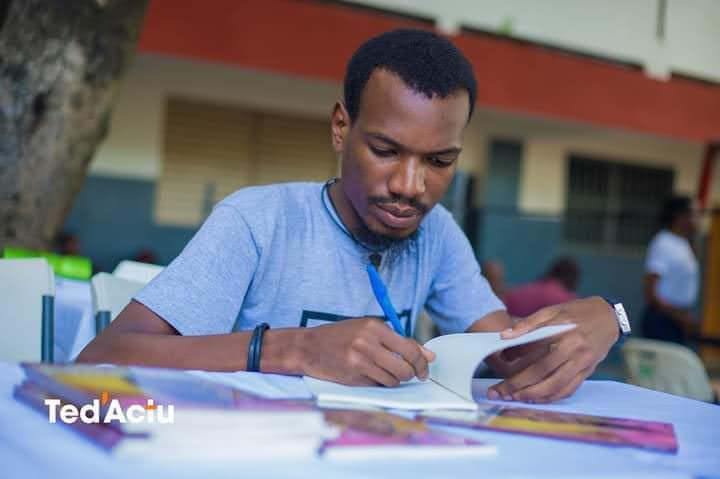
On the side of journalism, Joubert Joseph, a graduate student in Modern Literature at the École normale supérieure in Port-au-Prince, also dedicates himself to literature.
Alongside journalism, Joubert Joseph, a graduate student in Modern Literature at the École Normale Supérieure of Port-au-Prince, also devotes himself to literature. It is by following his muse that this author of three poetry collections wrote The Eyes That the Night Took, a piece he submitted to the RFI Theater competition. Out of 142 entries from 11 countries, mostly African, 13 were selected as finalists. The Eyes That the Night Took, by our colleague, is among this selection for the 2026 edition. For all fans of the journalist, the countdown is on. On Sunday, September 27, the RFI Theater Prize will be awarded in Limoges, as part of the Zébrures d’automne festival.Le Nouvelliste: You’re a journalist in the Culture section of Le Nouvelliste and also a poet. Today, you are among the 13 finalists for the RFI Theatre Prize 2026 with Les Yeux que la Nuit a pris. How are you experiencing this international recognition, which also marks your first venture into dramatic writing?
Joubert Joseph: I’m really happy to be among the 13 finalists for the RFI Theatre Prize 2026 with my play Les Yeux que la Nuit a pris. After three poetry collections (15 Poems for a Million Embraces, Léa or Beauty in a Thousand Pieces, Sezon Powèm), I wanted to challenge myself with another form, another writing language. Seeing this text reach this stage is already, for me, a huge joy and an invitation not to put down the pen.Le Nouvelliste: Your play opens with extreme violence: a businessman is left blind in a Port-au-Prince controlled by gangs. Why did you choose to tell the Haitian crisis through the perspective—or rather the loss of perspective—of a single man?
Joubert Joseph: What I wanted to do was question the role assigned to men in society, in the family, which sees them as people who must always take responsibility and can’t afford to be depressed or weak, no matter the circumstances. Men are often seen as superheroes. And that’s where all of Édouard Bélizaire’s anxiety comes from, after he becomes blind and can no longer work or take care of his family.Le Nouvelliste: Beyond the brutality of the events, your text raises this question: ‘What kind of world produces children capable of such violence?’ Were you more trying to understand the mechanisms of this violence or to denounce them?
Joubert Joseph: I would say both. Because the character Édouard Belizaire, a victim of the warlords, has a logical explanation for the phenomenon. But at the same time, that doesn’t stop him from denouncing it.
Humans are meant to take action
Le Nouvelliste: Despite the pain, The Eyes That the Night Took is presented as an ode to love, resistance, and hope. Was it important for you to offer a light in the heart of such a dark story?
Joubert Joseph: I can say yes, in the sense that Édouard is a broken man. He no longer feels like a man according to the classic definition of the term. Besides, what is a man who can’t maintain his house? Men are meant to take action, take responsibility, and not complain even when things go wrong. And this is where Marlène comes in, who, despite the wounds, tries to comfort her husband.
Le Nouvelliste: You are above all a poet. How has poetry shaped the way you write theater? Have you discovered another way to make the silences, emotions, and voices of the characters heard?Joubert Joseph: In my opinion, poetry is an extraordinary language, complex, but at the same time it can’t convey all kinds of messages. It can even soften certain shocks by using a gentler, sometimes less raw language. Theater was, in my view, the most appropriate medium to carry this speech. It’s another way for me to approach my favorite themes and to challenge certain societal customs. Poetry helps me because it makes it easier for me to build certain images in the text.
Le Nouvelliste: Your profession as a journalist puts you in daily contact with Haiti’s cultural and social reality. Does this practice of observation directly feed into your literary writing, or do you make a distinction between these two worlds?Joseph Joubert: The experience of everyday reality is very important for building a writer’s imagination. Obviously, this aspect helps me have a perspective on society. My observation practice as a journalist feeds, in a certain way, my literary writing. There is certainly a distinction between journalism and literature. However, some facts from the former can inspire the latter.
Le Nouvelliste: This selection for the RFI Theater Prize opens a new stage in your journey. Do you want to continue writing for the theater, and which Haitian stories do you still consider urgent to bring to the stage?Joseph Ouvert: I don’t plan on stopping with playwriting. This first piece is a way for me to dive into an adventure. And this adventure isn’t going to end anytime soon. I’m already thinking about other plays that I plan to write. But it’s still too early to say exactly what my next plays will be about.
Comments collected by Claude Bernard Sérant