
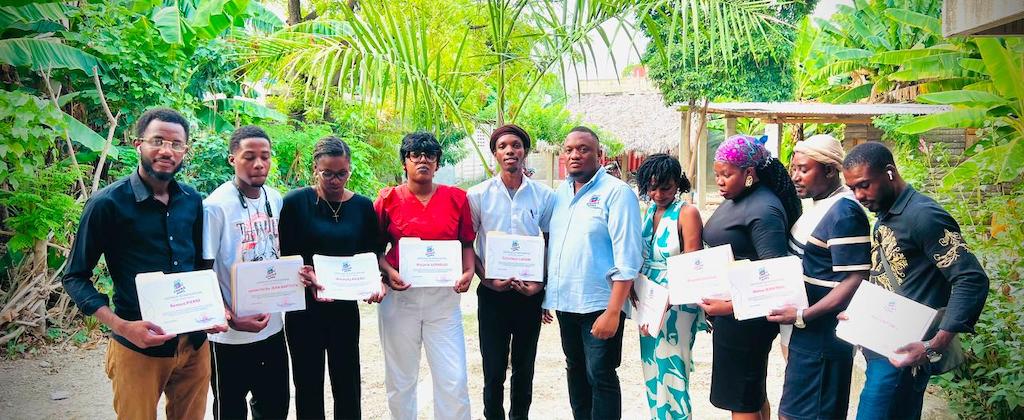
For its fourth edition, the Documentary Training Program (PDFD) takes a decisive step by setting up for the first time in Jacmel.
For its fourth edition, the Documentary Filmmaking Training Program (PDFD) reached a significant milestone by setting up in Jacmel for the first time. Through the theme “Jacmel, Living Memories,” thirty young people were introduced to documentary filmmaking while exploring the history, skills, and collective memory of their community. In this interview, Ralphden Laurent reflects on this experience where technical training transformed into a human adventure, making the camera a tool for cultural transmission, heritage preservation, and civic engagement.Le Nouvelliste: How did this 4th edition compare to previous ones? Why did the theme “Jacmel, Living Memories” particularly resonate with the 30 participants?
Ralphden Laurent: This 4th edition marks a turning point for the PDFD: it’s the first time the program has left Port-au-Prince to establish itself in the provinces. Choosing Jacmel to initiate this decentralization was a natural choice. For most of the 30 participants, this experience was their first immersion in documentary filmmaking. The theme “Jacmel, Living Memories” sparked a genuine awakening. Beyond learning filmmaking techniques, they discovered the possibility of telling their own stories, documenting their daily lives, and offering a fresh perspective on their community.Le Nouvelliste: What was the main challenge, technically or creatively, during these intensive weeks, and how did the participants overcome it?
Ralphden Laurent: The challenge was to absorb a significant amount of knowledge in just a few weeks. Moving from theory to practice, mastering the camera, sound, and the basics of editing is a demanding step for beginners. They met this challenge by accepting mistakes as an integral part of learning, by multiplying practical exercises in the field, and by relying on the strength of teamwork. Confidence is gained through practice, and they dedicated themselves with remarkable energy.A Powerful Moment
Le Nouvelliste: Can you tell us about an anecdote or a moment of sharing that particularly marked this 2026 graduating class?
Ralphden Laurent: One of the most moving moments occurred during a listening session of audio recordings. A group had recorded the testimony of an elderly craftsman from Jacmel, who revealed the secrets of making papier-mâché masks. Upon hearing his voice, both fragile and passionate, a profound silence fell over the room. At that moment, the participants realized that without such documentation, these skills and these stories risked disappearing one day.Le Nouvelliste: Why was it essential to link film training to the preservation of Jacmel’s tangible and intangible heritage?
Ralphden Laurent: Jacmel is an immense living heritage. But a heritage that ceases to inhabit the imagination of its youth eventually fades away. Cinema creates a natural link between generations. By giving these participants the means to document their city, we invite them to become keepers of memory rather than mere spectators. Their perspective brings a new way of telling our shared history.
Dynamics of Transmission
Le Nouvelliste: How did the residents of Jacmel react to seeing these young people documenting and exploring their collective memory?
Ralphden Laurent: The reception was one of kindness and pride. Initially, some residents were surprised to see these young people walking the streets with cameras, microphones, and boom mics. But curiosity quickly gave way to dialogue. From the very first exchanges, barriers fell. The elders were pleased to see that the new generation was interested in their stories, their experiences, and their memories. Little by little, a genuine chain of transmission was established in the neighborhoods.
A Creative Lab
Le Nouvelliste: Although the formal training is complete, the participants are continuing their work on the documentary about the collective memory of Jacmel. What are the next steps in this creative and production process?
Ralphden Laurent: The training doesn’t end with the awarding of certificates. This first stage has given them a solid foundation, but it now needs to be tested in the field. Our priority is to support the participants until the documentary is finished. They will continue filming, deepen their research, refine their perspective, and participate in the editing process with our guidance. This film is their true learning space, the one where their knowledge is solidified through real-world experience.Le Nouvelliste: How will this transition from “supervised learners” to “active creators in the field” take shape? What support is still being offered to them?
Ralphden Laurent: They are now entering a creative phase. The courses are gradually giving way to practical experience, where each shoot becomes an opportunity to learn and gain confidence. For our part, we continue to support them by providing equipment, workspaces, and technical guidance. We are also entrusting them with increasingly significant responsibilities so that they can develop their autonomy and their ability to manage projects professionally.A First in Jacmel, and Beyond
Le Nouvelliste: Where and when will the public be able to discover these documentaries? Are community screenings or participation in festivals already planned?
Ralphden Laurent: We hope to present the film as a preview in Jacmel by the end of 2026, at a screening open to the public, families, and all those who contributed to this project. It will be a moment of sharing with those whose stories inform the documentary. We will then organize a caravan of open-air screenings in several neighborhoods of the city so that these stories first reach their communities. Finally, the films will be submitted to festivals, both in Haiti and internationally, to showcase the perspective of this new generation of documentary filmmakers.
Le Nouvelliste: How does this program demonstrate that cinema can become a powerful tool for engaging Haitian youth in promoting their culture and history?Ralphden Laurent: This first experience in the provinces confirms that talent, creativity, and a thirst for learning are present throughout Haiti. In Jacmel, we met young people who were just waiting for an opportunity to express themselves. By giving them the tools to tell the story of their own community, filmmaking becomes a means of self-affirmation, transmission, and pride. These participants are no longer content to simply watch stories from elsewhere; they are beginning to write and film their own.
Le Nouvelliste: What message would you like to send to the partners, broadcasters, and institutions who are discovering the work of these 30 participants today, in order to ensure the sustainability of this initiative?Ralphden Laurent: This first PDFD project outside of Port-au-Prince confirms the relevance of our vision: to enable each region of Haiti to tell its own stories through film. But this initial success is just the beginning. To sustainably support this generation, and those that follow, we need partners willing to make a long-term commitment. Supporting this program means investing in creative youth, preserving a living heritage, and contributing to the emergence of a true national filmmaking network, where every region can have its voice heard.
Interview by Claude Bernard Sérant