
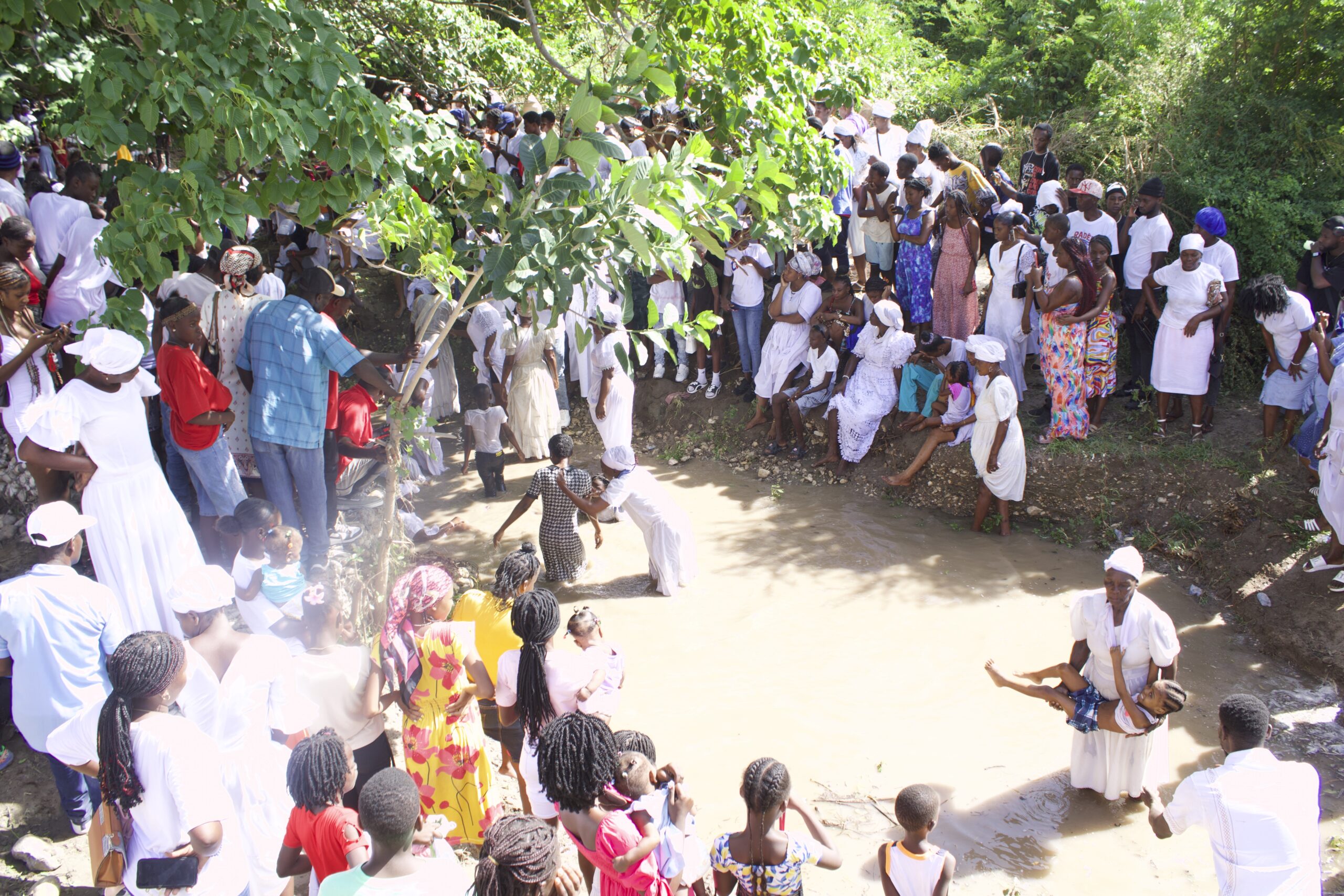
At Lakou Soukri, the sacred is experienced to the rhythm of drums, prayers, and the waters of Manbo Inan.
At Lakou Soukri, the sacred is experienced to the beat of drums, prayers, and the waters of Manbo Inan. In this sanctuary, pilgrims come seeking protection and healing, while Mathieu Painvier, an artist-researcher and someone familiar with the place for nearly forty years, shares what this memory-filled space means to him. But by the edge of the basin, another perspective shows up: that of health. Between sacred water, ecological concerns, and ritual practices, a question eventually emerges.On the day of the celebration of Manbo Inan, the drum first reaches us like a whisper. Then the sound swells as we move through Lakou Soukri. Around us, pilgrims come and go, in a continuous motion dominated by white and blue. We are in a sacred space, one of the three lakous that, according to Mathieu Painvier, form a trinity inherited from the Saint-Domingue colony: Lakou Soukri, associated with the kingdom of Congo; Lakou Souvnans, linked to the tradition of the kingdom of Dahomey; and Lakou Badio, connected to the kingdom of the Yoruba of Nigeria and to Ogo Badagri, god of war.
At the edge of a well, inside a Kay Lwa, Mathieu Painvier talks with servants of the lakou. The artist-researcher has been visiting Soukri for about forty years. He shares with us a memory that still seems to live within him: “The first time I came to Soukri, on my way back, I shed a tear. I wondered: why did our upbringing make us run away from everything.Mathieu Painvier, artist-researcher
That day, Mathieu is dressed in white, with a blue scarf wrapped around his head. He worships Inan, mother of all the children of the lakou. In this lwa house of the Manbo Inan section, he talks to us about this sanctuary and his relationship with this place.
In another part of this vast courtyard, we saw men and women dancing around a tree at the foot of which flows the blood of a bull offered as a sacrifice to a god.
Every space in this sacred architecture has a function, the artist-researcher reminds us.Mathieu Painvier, artist-researcher
That day, Mathieu is dressed in white, with a blue scarf wrapped around his head. He worships Inan, mother of all the children of the lakou. In this lwa house of the Manbo Inan section, he talks to us about this sanctuary and his relationship with this place.
In another part of this vast courtyard, we saw men and women dancing around a tree at the foot of which flows the blood of a bull offered as a sacrifice to a god.
Every space in this sacred architecture has a function, the artist-researcher reminds us.Walking along the fields, he follows the thread of his memories. Names pop up: Dany Danash, Konpè Filo, Ronald Derenoncourt, aka Aboudja, a journalist who, according to him, helped bring together a group of artists who enriched roots music. He remembers a few musicians: Théodore Beaubrun Junior (Lòlò), Louis Lesly Marcelin (Samba Zao), Eddy François, Harry Thysfield, and others.
Mathieu also worked for years alongside the Haitian filmmaker Arnold Antonin on several films. When he talks about Soukri, the past seems to take on the colors of a golden age.
But he doesn’t just tell stories. He invites us to walk with him.
The path to Manbo Inan
We follow Mathieu to the Manbo Inan basin. The further we go, the more the drum takes over.Hundreds of people are crowding around a natural pool protected by trees. Mathieu watches the pool. He notices that the water has decreased significantly. For him, this drop is also the result of human activity and ecological changes. He worries: ‘If nothing is done, the Manbo Inan pool will disappear.’
In the middle of the crowd, mothers hand their children over to manbo. Some are possessed by lwa. The children are then immersed in the yellowish water of the pool.
This is when another perspective enters the scene.
The young journalist from our team, Marc-Kerley Fontal, a member of the Haitian Health Journalists Network, naturally asks the health question: ‘But the water is dirty. How can you bathe in it?’
Mathieu doesn’t leave the question unanswered: ‘It’s a natural pool. This place surrounded by trees is sacred. It’s healing water. Manbo Inan is a spirit linked to water. This pool is the soul of her cult.’Two gazes have just met at the edge of the same water.
It’s in that space where the spiritual, the ecological, and the sanitary intersect that a question hangs over the water: what risks does this water pose to those who dive into it?

