
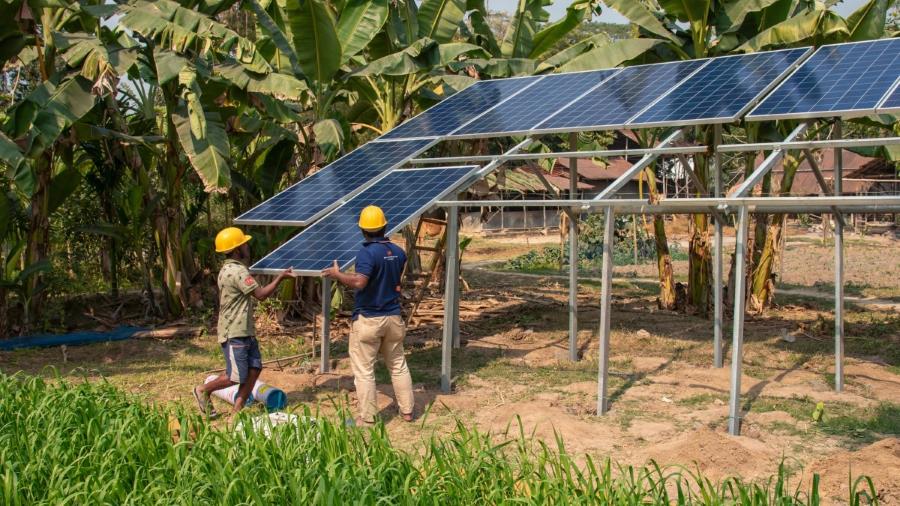
The fourth edition of the Quisqueya University (UniQ) Autumn and Summer School is focusing this year on funding and governance of the energy transition in Haiti.
The fourth edition of the Fall and Summer School at Quisqueya University (UniQ) this year is focusing on financing and governance of the energy transition in Haiti. From September 21 to 23, 2026, students, professionals, and experts are invited to think about the legal, institutional, and technical mechanisms needed to develop a more efficient and sustainable energy sector.
The Haitian energy sector can no longer be looked at purely from a technical perspective. For the organizers of this fourth edition, governance, financing, and the legal framework are also key conditions for the success of projects and the transformation of the energy system. “We believe that governance is a more transparent and ongoing way of providing a service […] to build a bit of trust between investors and citizens,” explains Dr. Hussein Supreme, on Magik9 on September 16, 2026, as part of the initiative.Organized around the theme ‘Financing and Governance of the Energy Transition: Legal Mechanisms and Technical Framework for Effective Action,’ this edition aims in particular to discuss the conditions that allow energy projects to be viable over time. According to the organizers, legal and institutional mechanisms must support technical solutions to ensure the sustainability of projects. The goal is also to boost investors’ and citizens’ confidence in the sector. The discussions should therefore help identify the weaknesses of the current system, as well as examine experiences developed in other countries and think about how to adapt them to the Haitian context.
Funding, a key issue
The question of funding plays an important role in this discussion. Transforming the energy system indeed requires investments and mechanisms that can support infrastructure and new technologies. According to the organizers, Haiti should also see its lag in energy development as an opportunity to build solutions suited to the country’s realities, rather than simply copying models from elsewhere. Energy transition is thus seen as a chance to move toward solutions that rely more on renewable energy, energy efficiency, and electrification of uses.One of the key messages put forward in this discussion is the need for Haiti not just to try to catch up, but to think directly about the energy models of tomorrow. “Instead of seeing it as a weakness, instead of seeing it as a lag, I actually think it’s an opportunity,” says Hussein Supreme, supporting the idea of a system more oriented toward renewable energy and decentralization. This approach also needs to take the whole energy system into account. It’s not just about producing electricity, but about considering the infrastructure and technologies related to the production, transport, distribution, and consumption of energy.
International experiences to adapt to Haiti
The Autumn and Summer School also aims to encourage exchanges with specialists who have worked on energy issues in different contexts. Experiences from countries like Guinea-Bissau, Nigeria, Canada, and Quebec will be presented to the participants. The goal is to learn from these experiences while taking into account Haiti’s own realities. The program includes discussions on energy sector roadmaps, development plans, and the financial and technical performance of electricity distribution companies.The initiative is not limited to students from the organizing universities. Young professionals, experienced professionals, and anyone interested in energy issues are also invited to participate. The activities are expected to be held in a format that allows online participation, with opportunities to attend in person as well. Through this fourth edition, Quisqueya University and its partners aim to broaden the discussion on the energy transition in Haiti. Financing and governance appear as two of the necessary conditions to move from ideas and projects to concrete transformations in the sector.
The energy transition is not just about introducing new technologies. It also raises the question of the framework within which these technologies will be funded, regulated, and implemented, with the central need to build an energy system better adapted to Haiti’s realities.

