
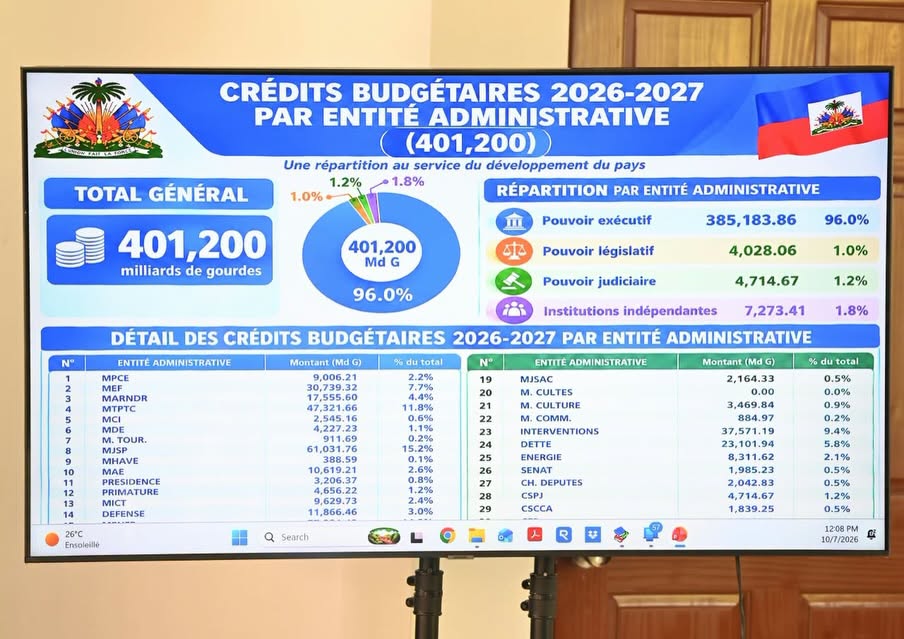
A week after announcing the adoption of a budget for the 2026-2027 fiscal year, the government, represented by the Minister of Economy and Finance, Serge Gabriel Collin, and the Director General of the Budget, Michel Silin, laid out the main budget highlights.
A week after announcing the adoption of a budget for the 2026-2027 fiscal year, the government, represented by the Minister of Economy and Finance, Serge Gabriel Collin, and the Director General of the Budget, Michel Silin, laid out the main budget plans. The numbers, directions, priorities, and challenges related to the new budget, which has a total amount of 401.2 billion gourdes, were presented and explained.In terms of expressed priorities, the 2026-2027 budget comes back with the same ones that were outlined for the previous fiscal year: restoring security, continuing with the electoral process, and economic recovery. “There are budget forecasts for spending related to organizing elections and the salaries of the new officials who will come out of the upcoming elections. Security, being the top priority, the government has allocated the largest share of the pie to the National Police of Haiti (PNH). The Haitian Armed Forces (FAd’H) will also cover part of the expenses planned for restoring security. Regarding economic recovery, one of the major points of this budget, the government is opting for investments in the departments of the greater North and greater South, which are the least affected by the current insecurity crisis.”said Serge Gabriel Collin, pointing out that the Ministry of National Education and Vocational Training (MENFP), which receives the largest budget after the PNH, is also one of the government’s priorities.
Restoring security to get back to economic growth is the biggest challenge faced with this budget, according to the Minister of Economy and Finance, Mr. Collin. The government expects economic growth to pick up around 0.5% by the end of the current fiscal year. “What allowed us to plan for a return to growth when preparing the budget is the promise of a gradual improvement in the security situation throughout the current fiscal year. Better security will boost job creation in the economy and attract investors with fresh capital to create new wealth. As a result, the state expects to collect more taxes, duties, and fees,” said the country’s top finance official.Another challenge has been identified by the government. It’s controlling current spending, the Minister of Economy emphasized. “What we see, year after year, is that the state hires more people because of the multidimensional crisis affecting the country. Every day, there are more people who want to find a job in the public sector. Everyone needs to understand that current spending cannot contribute to the country’s development. Only investment spending can lead the country toward development. In fact, to achieve development, the establishment of basic infrastructure like roads, hospitals, etc., is necessary. Haiti has huge potential in tourism, and infrastructure is also needed for the development of this sector,” said Serge Gabriel Collin, confident that the country will get back on the path to development if the goals are met.
During the press conference, the Director General of the Budget, Michel Silin, spoke about the macro-budget aggregates and the resources planned in the budget for this fiscal year. He also highlighted the findings made while preparing the budget. “The situation is alarming, the country is going to experience an eighth year of contraction in its Gross Domestic Product (GDP). Haiti closed the 2025-2026 fiscal year with negative growth, at -1.5%. A drop in GDP means a reduction in state revenue. In this case, the expected resources don’t come through. Yet, the state still has to cover its expenses, which explains the budget deficit recorded this year, making financing by the central bank unavoidable,” explained Mr. Silin. The monetary financing by the Bank of the Republic of Haiti (BRH) reached 16.5 billion gourdes during the past fiscal year.At the beginning of the said fiscal year, the government had planned not to use this type of financing before including it in the revised budget in June. A level of monetary financing of around 16 billion gourdes was planned at that time.In this new fiscal year, the government is already expecting a budget deficit and plans to knock on the BRH’s door for monetary financing of around 4.2 billion gourdes. The head of the General Directorate of Budget (DGB) highlighted the need for spending on restoring security, funding elections, salaries and operating conditions of the new officials, as well as the functioning of Parliament and the Presidency. However, he acknowledged that monetary financing causes inflation, which erodes citizens’ purchasing power. On this point, the government is pleased to have managed to slow the inflation rate, which dropped to around 17.3% for the 2025-2026 fiscal year. For the current year, it aims to contain it even further to around 15.8%.As far as the allocation of budget resources is concerned, the executive branch really went for it by giving itself 385.18 billion gourdes, or 96% of the total planned budget resources, compared to 4 billion gourdes for Parliament, or 1%, and 4.71 billion gourdes for the judiciary, or 1.27%. It’s worth noting that the budget for the judiciary and that of independent institutions together make up only 3% of the budget resources planned for this current fiscal year.
This budget will be largely funded by the General Administration of Customs (AGD) to the tune of 129 billion gourdes, not including taxes on petroleum products. Oil revenues are estimated at 36 billion gourdes according to forecasts. So, the AGD will contribute a total of 165 billion gourdes. As for the General Directorate of Taxes (DGI), it will provide 95 billion gourdes to the budget. In the sections Other internal project financing and Other resources, contributions of 3.2 and 2.9 billion gourdes are planned, respectively. Donations and loans, among other things, make up the other sources of budget financing.Regarding expenses, the government has planned, among other things, that current expenses will be around 232.6 billion gourdes, goods and services 77.8 billion gourdes, subsidies 26.5 billion gourdes, and debt interest 6.6 billion gourdes. There is also an exceptional expense estimated at 8.6 billion gourdes in the budget. As for current expenses, they represent 57.9% of the budget. Investment expenses are forecasted at about 168 billion gourdes, or 42.1%. It is therefore planned to draw 50 billion gourdes from the Public Treasury for investments.

