
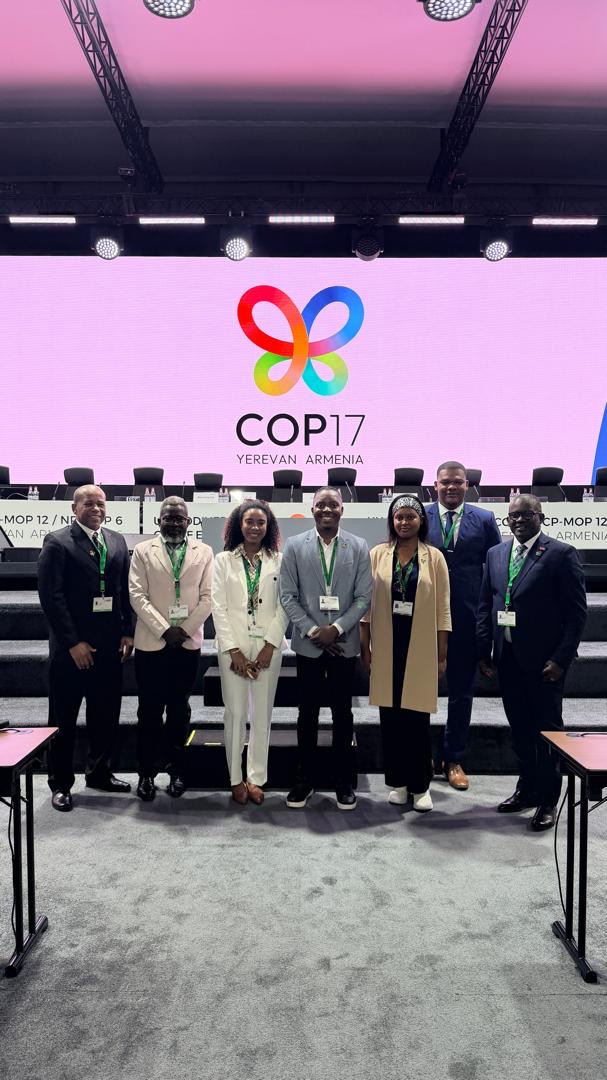
At the COP17 on biodiversity, held in Yerevan from October 19 to 30, 2026, Haiti advocated for better access to funding, environmental education, and strengthened international cooperation
Under the theme “Taking Action for Nature,” the 17th Conference of the Parties to the Convention on Biological Diversity (COP17) brought together representatives from the 196 Parties to the Convention in Yerevan, from October 19 to 30, 2026. This meeting marked the first global review of collective progress in implementing the Kunming-Montreal Global Biodiversity Framework, adopted in December 2022 at COP15. With just four years to go until the 2030 deadline, discussions focused in particular on the ways needed to turn international commitments into concrete actions.For Haiti, access to financial resources remains one of the main obstacles to implementing its commitments. The country has an updated National Biodiversity Strategy and Action Plan (NBSAP), structured around five strategic axes and 29 targets. These guidelines focus in particular on the conservation, restoration, and sustainable use of biodiversity, as well as its integration into public policies. The country has also approved a Biodiversity Financing Plan aimed at identifying needs, guiding investments, and diversifying funding sources. However, the available resources are still far from sufficient compared to the estimated needs.
According to the financing needs assessment carried out as part of the UNDP BIOFIN initiative, implementing the national strategy from 2026 to 2030 will require about $827.3 million USD. This finding was at the heart of the advocacy presented by Emmanuel Jean-Philippe, Director General of the Ministry of Environment and head of the Haitian delegation. At the COP17 podium, he called for easier access to financial resources and stronger international cooperation to support efforts in ecosystem conservation and restoration.”Financial mechanisms should be designed to make it easier to carry out actions on the ground, not to hinder their implementation,” said the Haitian representative. He specifically called for simplifying access procedures for funding, shortening approval times, and providing technical support suited to the capacities of the recipient countries.Environmental education and cooperation at the heart of priorities
Beyond financial resources, Haiti has identified environmental education and international cooperation as two key levers to slow down biodiversity loss. The Haitian representative called for more investment in education, awareness, and citizen participation to instill a culture of nature protection from an early age. According to Mr. Emmanuel Jean-Phillippe, preserving biodiversity cannot rely solely on government policies and investments. It also requires the involvement of young people, local communities, businesses, and all citizens. “Without lasting changes in behavior, our policies and investments will remain insufficient,” he emphasized.Scientific and technical cooperation is another priority supported by the delegation. Haiti especially wants to strengthen technology transfer, knowledge sharing, and regional partnerships to build up its national capacities, restore ecosystems, and better protect its biological heritage.Towards strengthening the national legal framework
Legally, Haiti has also shown interest in joining the Cartagena Protocol on Biosafety and the Nagoya Protocol on Access to Genetic Resources and the Fair and Equitable Sharing of Benefits Arising from their Utilization. To date, the country is not a party to either of these two instruments. Ratifying or joining them, followed by implementation, would notably help better regulate the risks associated with genetically modified organisms and access to genetic resources, while also strengthening mechanisms for sharing the benefits derived from their use.In Yerevan, Emmanuel Jean-Philippe stated that measures had been taken to strengthen national environmental legislation, particularly regarding the prevention of risks associated with genetically modified organisms. This effort is intended to support Haiti’s expressed desire to join the two protocols. While the Kunming-Montreal Global Biodiversity Framework sets goals to be achieved by 2030, the challenge for Haiti now is to turn its commitments into concrete actions, backed by sufficient resources and appropriate protection mechanisms.
This issue is even more important because the country is home to remarkable biological heritage, marked by the presence of many species endemic to Haiti and Hispaniola. These species, some of which are found nowhere else, represent an irreplaceable ecological wealth. Therefore, their disappearance would constitute an irreversible loss, not only for Haiti.

