
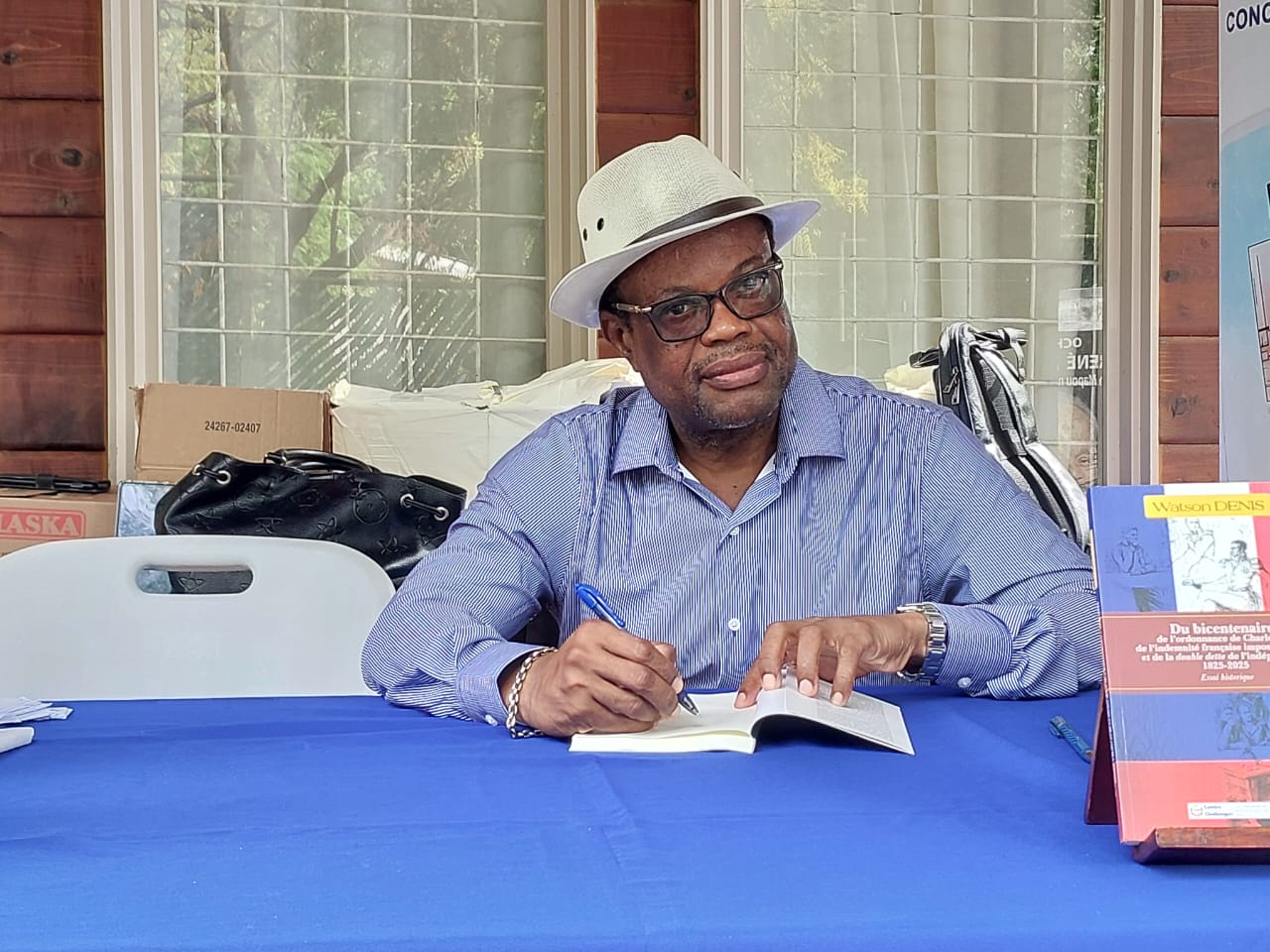
Watson Denis signed, at the National Book Directorate (DNL), on Tuesday, October 27, 2026, two important books on the history of Haiti and France.
It was in an attractive setting that historian Watson Denis presented his two works at the DNL: Haiti and France, The Double Debt of Independence: Historical Ransom, and From the Bicentennial of Charles X’s Ordinance, the French Indemnity Imposed on Haiti, and the Double Debt of Independence 1825-2025 (Historical Essay).
In these freshly published works, under the presses of Centre Challenges, the professor revisits one of the most painful and debated episodes of national history: Charles X’s 1825 ordinance, through which France made the recognition of Haitian independence conditional on the payment of 150 million gold francs.A Story and an Essay
The first work, Haiti and France: The Double Debt of Independence: Historical Ransom, is a narrative in three chapters. Watson Denis recounts how King Charles X sent a large military expedition to Haiti to enforce his decree. He describes the arrival of the ships, the Haitian government’s reaction, and the decisive points of the negotiations. He also explains how President Jean-Pierre Boyer eventually agreed to the decree, and then what happened afterwards. In conclusion, he broadens the discussion to the debt of countries dominated by major powers.The second, Du Bicentenaire et l’Ordonnance de Charles X…, is a historical essay. In it, the author offers, with references and notes, a critical reflection on the evolution of the debt over two centuries. He examines how the Haitian state, successive governments, and notable figures of the country responded, and how the debt was eventually paid off. Lacking resources, he says, the country had to face this burden through what amounts to real financial ‘surgery.’
A ransom Haiti should not have paid
The central thesis is that the double independence debt was a ransom. Haiti had declared its independence on January 1, 1804, and according to the historian, lived in total sovereignty until 1825. It was the acceptance of the royal ordinance that led it into neo-colonization. For over 150 years, the country paid a sum it shouldn’t have, which, he argues, justifies the term ‘historical ransom.’He puts Charles X’s decision into context. Negotiations between Haiti and France had started as early as 1814. By around 1821, Paris apparently realized that restoring slavery had become impossible and then sought another form of control. The 1825 Ordinance fits into this logic of recolonization. Officially, it was meant to compensate the former colonists who had lost their properties during the Revolution, but for the author, the real issue was protecting French interests.
He also points out that in 1825, France only recognized independence in a “conditional” way: Haiti had to keep paying. It wasn’t until 1838, through an agreement, that the recognition was full, and the remaining debt stayed the responsibility of the Haitian state.An irony of history
One of the most striking parts of the essay is the end of this story. According to Watson Denis, the last cent was paid in 1945, under the government of Dumarsais Estimé. But it wasn’t to France that it was paid. In 1922, under American occupation, the foreign forces had imposed the consolidation of Haitian debts, including the double debt, and Haiti had to borrow from the United States to pay it all off. So from 1922 to 1947, the country was repaying an American bank. To settle the remaining balance, the government at the time had asked the population for help, and many Haitians contributed a few cents or a few gourdes.Repair and development
When asked about a possible restitution, the historian thinks it would be “a very good thing” for a country facing a serious lack of capital, especially since the double debt drained the national treasury throughout the 19th century and much of the 20th. He believes that if this money had stayed in Haiti, it could have funded schools, hospitals, and roads.
However, he warns against any simplistic reading: debt isn’t the only cause of underdevelopment, and poor governance also plays a big role.A Wide Audience
Watson Denis says he relies on archives, but also on work that has already been published in Haiti and abroad. His contribution, he explains, is to make two books that deal with the issue in detail accessible to the Haitian public. He considers them complementary and says they can be read in any order. The reception has been good so far, and the books are now in the promotion phase.
He invites academics, students, teachers, civil servants, economists, diplomats, and researchers to read them. Beyond debt, they also cover, in his view, politics, the economy, and Haiti’s place in international relations.About the Author
A graduate in Social Sciences from the École Normale Supérieure (UEH) and holder of a master’s degree in international relations as well as a PhD in history, Watson R. Denis is a multi-skilled academic. He teaches Caribbean history, Haitian social thought, and the history of international relations at UEH, among other subjects. He has published the following works in Haiti: The Association of Caribbean States: Organizing the Greater Caribbean (2013) and Haiti: Beyond January 12, 2015: Law, Politics, and Constitution (co-authored), both with C3 Editions. Dr. Denis is the executive director of the Challenges Center.

