
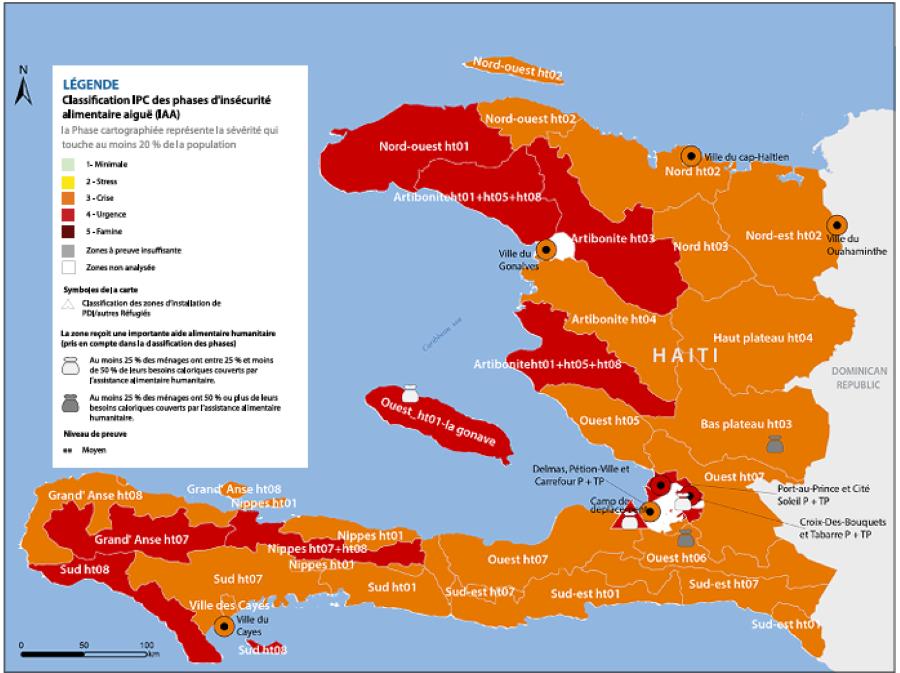
Nearly six million people in Haiti are affected by high levels of acute food insecurity (phase 3 or higher) according to the Integrated Food Security Classification (IPC), from September 2026 to February 2027, based on a food security overview carried out by the National Food Security Coordination (CNSA) and its IPC partners, which was published on October 28, 2026.
Nearly six million people in Haiti are affected by high levels of acute food insecurity (phase 3 or higher) according to the Integrated Food Security Phase Classification (IPC) framework, from September 2026 to February 2027, according to a food insecurity outlook conducted by the National Food Security Coordination (CNSA) and its IPC partners, published on October 28, 2026.
“About one in two people, therefore, cannot regularly access enough food or have to resort to emergency coping strategies for their livelihoods to get by,” the report reads, noting that around 1.8 million people, or 16% of the population, are in an emergency situation (phase 4 of the IPC).The people affected by the emergency are concentrated in areas hit by insecurity, displacement, and economic marginalization. Their situation is particularly worrying. “Thus, 10 out of the 30 analysis units in the country are classified as Phase 4, including displaced persons’ sites, vulnerable population groups in the underprivileged neighborhoods of the Port-au-Prince metropolitan area (Croix-des-Bouquets and Tabarre, Port-au-Prince, and Cité Soleil), as well as several areas in Artibonite, Grand’Anse, Nippes, Northwest, and South,” according to this IPC analysis report.”The number of people facing high levels of acute food insecurity has increased by 240,000,” IPC analysts said.
Three main factors were identified to explain the worsening food insecurity in Haiti: armed violence, the prolonged economic crisis, and low agricultural production combined with climate shocks. Armed violence continues to cause large-scale displacement and economic, social, and territorial disruptions. By fragmenting food systems and blocking humanitarian access, insecurity weakens livelihoods and worsens food insecurity, the report says, noting that the West, Artibonite, and Central regions are among the most affected, but the effects of violence are felt throughout the country, with 1.49 million people displaced.Regarding the prolonged economic crisis, the report notes the persistent economic decline and inflation that continue to erode household purchasing power and limit their access to food. “The scarcity of livelihood opportunities, rising living costs, and falling incomes are deepening food consumption deficits. Households are therefore increasingly relying on crisis and emergency coping strategies,” according to the IPC analysis.
Low agricultural production and climate shocks also have harmful impacts on food security. “Structural constraints, environmental degradation, and insecurity continue to compromise agricultural production and rural livelihoods. Haiti remains highly vulnerable to the 2026-2027 El Niño event. Climate-related production losses could reduce food availability and agricultural incomes,” the analysis reads.Looking ahead, the CNSA and its IPC partners are predicting a worsening of food insecurity by the end of the first quarter of 2027. “About 6.35 million people out of the 11.2 million analyzed are likely to face high levels of acute food insecurity (IPC Phase 3 or higher) between March and June 2027.”

