
In Georgia, composting helps soil health, product safety, and waste reduction
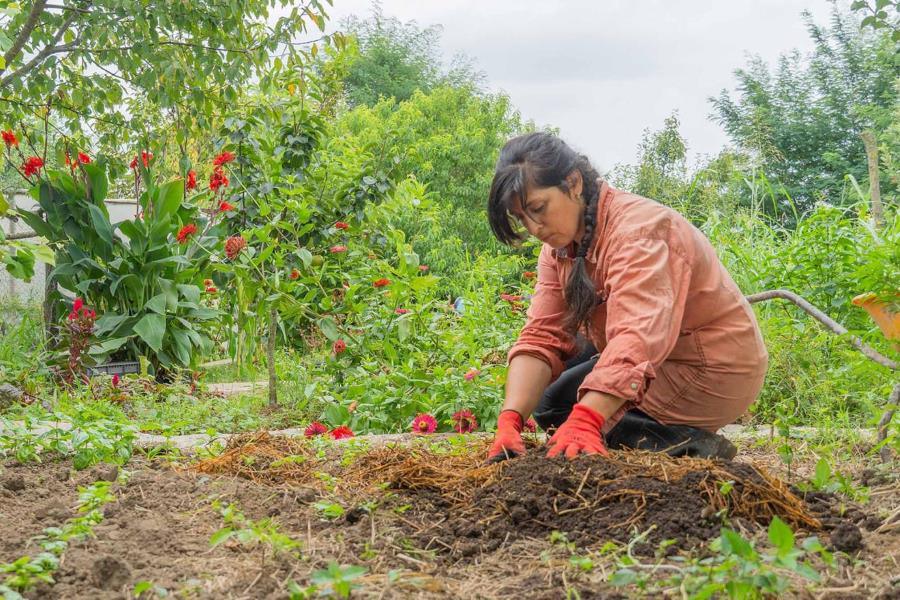
Nana Nikuradze changed her farming practices by joining a FAO farm school supported by the EU and Sweden, because for the first time, she’s making compost from plant residues, letting it decompose and turn into organic fertilizer.
Nana Nikuradze isn’t trained as an agronomist; she studied Germanic studies. Yet, after having children, she decided to grow healthy produce to feed her family. So, when she and her husband started growing vegetables, farming became her main activity.
“I’ve always wanted to provide healthy food for my family,” she says. “Later on, I decided to share it with others too.”With her husband and their three children, she manages a hectare of farmland in Samtredia, in western Georgia. They grow sweet peppers, eggplants, tomatoes, hot peppers, melons, and corn. In good years, they sell their surplus produce at the market in Kutaisi, the nearest big city.
During these eight years of vegetable farming, Nana has mostly practiced traditional agriculture, following in the footsteps of her parents and husband. She started changing her approach two years ago when she joined a farm school supported by the European Union and the Government of Sweden. Several of these schools were created as part of the European Neighbourhood Programme for Agriculture and Rural Development (ENPARD IV), implemented by the United Nations Food and Agriculture Organization (FAO).The goal of school farms is to promote safe and efficient use of pesticides while training farmers to take care of soil health, manage seeds and water effectively, and reduce plant residues through composting, all with the aim of organic production.
This year, for the first time, Nana is making her own compost from agricultural residues, straw, green plant material, and manure from her small dairy herd; layered together, they decompose to form an organic fertilizer.
“My goal is to replace 100 percent of chemical fertilizers with organic compost to produce even healthier food,” she explains.
She notes that it’s also a new way of thinking about waste. In the past, farmers in her village used to burn crop residues and other plant material waste instead of using them to enrich the soil.”It was destroying the soil biomass and also killing helpful insects,” explains Nana. “What used to go up in smoke now goes back to the earth. This way, we save on fertilizers and produce healthier food.”Getting rid of chemical inputs might lower yields at first, but it brings benefits: healthier soil and the return of helpful insects. These benefits build up and become more noticeable over the years. ©FAO/Guram Saqvarelidze
Nana barely uses any pesticides, herbicides, or insecticides, mainly because she keeps several beehives for pollination and wants to avoid putting them at risk. When pests show up on her plot, she and her family deal with them by hand using pheromone-based traps provided by the FAO’s farming school.According to Rati Kharshiladze, an agronomy and extension specialist at the FAO, ‘giving up chemical inputs might lead to a slight drop in yields, but this is offset by benefits: healthy soil, the return of helpful insects, and produce free from pesticide residues. These benefits don’t just last for one season—they build up over the years. They keep increasing as long as the practices are followed.’A different look, a better taste
Nana’s products don’t always look like what consumers are used to seeing. “My broccoli isn’t as big as the ones that get chemical fertilizers,” she explains. “But their aroma and flavor are unmatched.” She adds that the same goes for her watermelons and melons, which are smaller but taste better.
For her, this bias about how products look shows a real lack of consumer awareness; she hopes this gap will be filled and that farmers who work without chemical inputs will get more support.On her one-hectare plot, Nana would like to one day build a few small cottages to host visitors and allow them to discover her practices and take part in them. She imagines her guests harvesting vegetables alongside her, learning to prepare traditional Georgian dishes with freshly picked products, or even trying their hand at making their own compost pile.
“Everything I do here, I want to share with them,” she says. In addition to the cottages, she plans to raise her small herd of dairy cows as well as a few chickens, “just enough to show visitors how people live in a Georgian village.”
“For me, villages that strictly practice healthy habits are the strength of a country. We recycle what was once considered waste to produce energy again through organic fertilizer. That’s why I would like city dwellers to discover what a village truly is, The ENPARD program has reached over 1,500 farmers across Georgia, who have benefited from on-site training. Aimed at reducing poverty in rural areas, this initiative promotes the development of Georgia’s cultural potential and opens up economic opportunities for rural communities. Since 2021, it has also been helping to improve food safety in the country thanks to additional funding received from the Government of Sweden and the Czech development agency.

